Seedance 2.0 vs Fast vs Mini: Is the Cheap One Enough? (2026)
28 clips across all three Seedance 2.0 tiers, every prompt and price published. The cheap tier holds up — the real question is how many attempts you need.

ByteDance ships Seedance 2.0 in three tiers: Seedance 2.0, Seedance 2.0 Fast and Seedance 2.0 Mini. Same model family, three prices.
If you want the short version: default to Mini, and spend the difference on more attempts. Across six prompts no tier reliably won — the expensive one skipped details the cheap one caught, and the other way round — so the decision is less about which model is better than about how many attempts you can afford. Step up to the full Seedance 2.0 for 1080p and 4K — the one advantage that isn't a coin flip. Fast costs 60% more than Mini and never opened a clear gap over it.
What a 5-second clip costs:
| Config | Cost per 5s clip |
|---|---|
| 2.0 @ 480p | $0.35 |
| 2.0 Mini @ 720p | $0.38 |
| 2.0 Fast @ 720p | $0.61 |
| 2.0 @ 720p | $0.76 |
| 2.0 @ 1080p | $1.89 |
The two bolded rows cost about the same. So roughly $0.36 buys you either the top model at low resolution or the cheapest model at high resolution — two dials, not one, and almost everyone only ever turns the tier dial. We test the other one further down, and it doesn't go the way the pricing suggests.
Same capabilities, three prices
ByteDance's own guidance says the three "support largely the same features", and the spec sheets bear that out — everything is identical except the resolution ceiling: 4–15 second duration, all six aspect ratios, native audio, first and last frame control, nine reference images, three reference videos, video editing and extension.
The only feature difference: Fast and Mini stop at 720p. The flagship goes to 1080p and 4K.
The price ratio between them is a clean 2 : 1.6 : 1. Mini is exactly half the flagship, and Fast sits awkwardly in between.
And the gap doesn't buy extra capability. Ask all three for the same 5-second 720p clip and they bill for identical work — 108,900 video tokens each — with the price differing only because the rate does — 7.0, 5.6 and 3.5 per million tokens, with the flagship's 1080p output in a band of its own at 7.7. So the flagship has to earn its money on screen, in sharper detail, or in shots that land the framing and the details you asked for. Whether it does is what the rest of this post is about.
How we tested
We ran six prompts through all three tiers at identical settings — 720p, five seconds, audio on. Then we took the most demanding shot out to 10 and 15 seconds, added a 480p pass to test the resolution question, and one 1080p clip for the top of the range. 28 clips, $22.19, all of them below.
Each prompt is printed above the clips it produced, so you can run any of them yourself.
Two things to be straight about. Every clip is a single generation — nothing cherry-picked, nothing averaged. And you won't get these exact clips back if you run the prompts yourself. Seedance doesn't repeat a generation, even given the same seed — ByteDance says so: the same seed value produces "similar results, but complete consistency is not guaranteed." We confirmed it on all three tiers.
Animating a photo
Animating a photo — a pet, a baby, yourself — is one of the most common things people want from AI video, and it's missing from every tier comparison we could find. We gave all three the same source photo and nine sloppy words:
make the dog dance, keep his face the same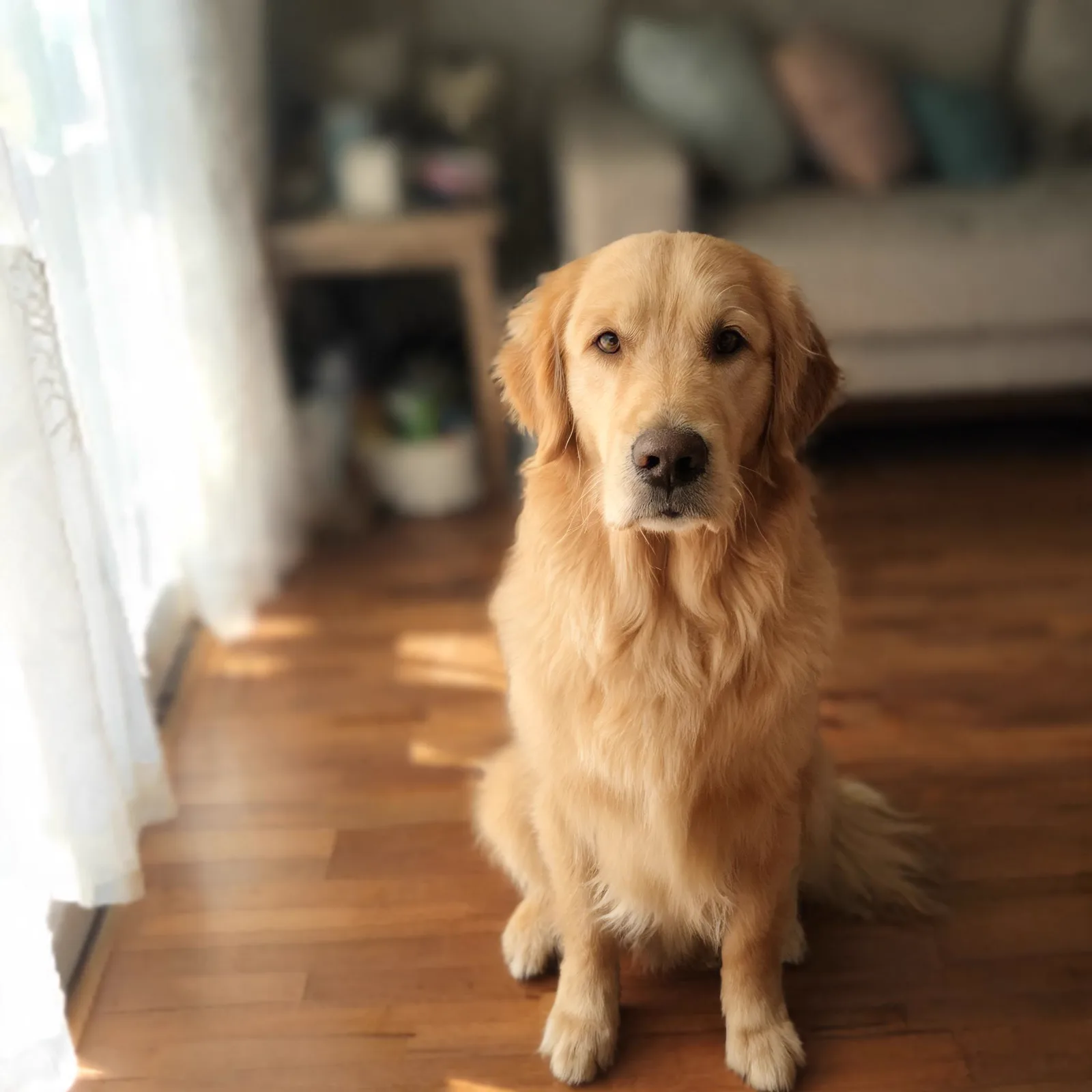
2.0
2.0 Fast
2.0 Mini
All three hold the dog's identity — same face, same coat, same room. What differs is how much happens in the shot. The flagship's tail swishes and its head tilts through the take; Mini mostly holds a sit. Neither one dances, to be clear. But one of them is trying — Mini renders the subject faithfully, then does less with it. It's the pattern we saw most often, though on one draw per prompt we can't tell you it's reliable.
The talking head
Vertical, scripted dialogue, phone-style framing — the highest-volume real use case, and the one where lip-sync failure is most obvious. Turn the sound on for this one.
A woman in her late 20s sits in a bright home kitchen, holding a small skincare bottle up to the camera, talking directly to the viewer like a friend. Natural handheld phone framing, vertical. She says: "Okay so I've been using this for three weeks and I genuinely cannot go back. Two drops, morning and night, that's it." Warm daylight from a window on her left. Casual, unpolished, real — like a TikTok, not a commercial. No text on screen.2.0
2.0 Fast
2.0 Mini
All three deliver the brief: vertical phone framing, a real kitchen, and a convincing read of the script — the lip-sync holds on all three. Past that they're hard to tell apart — each holds eye contact, keeps the bottle in frame, and stays the same person for five seconds. The flagship's kitchen is the brightest and the most contrasty; Mini's is dimmer and flatter, with the softest range between highlight and shadow. That's a difference in take, not in quality.
On the highest-volume use case there is, the cheap tier gives up nothing you can see.
The product shot
A perfume bottle on a reflective surface is the default demo in these comparisons — wiro floats one over black water, Cutout pushes in on one in golden-hour light — so we ran one too. This is where we expected the flagship to walk away with it.
Luxury perfume bottle on a polished marble surface, slow camera orbit, golden light, water droplets on the glass, cinematic product commercial2.0
2.0 Fast
2.0 Mini
It didn't. Judged against the brief rather than against taste, the flagship and Mini both deliver every element: bottle upright on polished dark marble, golden light, water droplets beaded on the glass. Side by side the stone, the veining and the lighting are near-indistinguishable — Mini throws light rays across the background, the flagship keeps it plain, and that is the whole of it.
Fast is the odd one out. It renders the most literal marble and the heaviest droplets of the three, then lays the bottle flat on its side and shoots it in extreme macro, with an illegible label smeared across the top. At half again Mini's price.
Which points at the thing that actually decides your bill: you will regenerate shots, and every regeneration is charged. Nobody lands a usable clip first try every time. That, not the sticker price, is the real case for the cheap tier — Mini buys you two attempts at a shot for exactly what one flagship attempt costs.
Motion, and reading the brief
skateboarder doing a kickflip down a set of stairs, camera following him, city street, afternoon2.0
2.0 Fast
2.0 Mini
All three produce a plausible kickflip, board and rider behaving sensibly. They part company on the setting the prompt described — a city street, and a set of stairs. Fast and Mini both find one: Fast an urban plaza with a staircase and handrails, Mini a street of storefronts and traffic lights with steps in shot. The flagship finds neither, dropping the skater on a suburban sidewalk to pop off a curb.
Neither of them reads the direction, though. The prompt said a kickflip down the stairs, and Fast and Mini both send him up — right trick, right obstacle, backwards. Prompt adherence, not fidelity, is where these models are weakest, and it doesn't track price: the two cheaper tiers at least found the staircase. It is also the weakness better prompting can fix (our director-language guide covers the phrasing that sticks).
Create AI videos with Pixo
Turn any idea into a publish-worthy video. One sentence is all it takes.
Where they disagree
The character test is the one that pulled the tiers furthest apart. Same man, single overhead light, head turns left and back — the shot that stresses identity under a turn and hard side lighting.
A man in a green jacket stands in a parking garage under a single overhead light. He turns his head fully to the left to look at something off-camera, then turns back to face front. Same face throughout, no changes to his features. Camera static, medium shot.2.0
2.0 Fast
2.0 Mini
Every tier holds the face through the turn. Two things separate them, and they point in opposite directions.
Framing. The prompt said "medium shot." The flagship delivered one. Mini pulled back to a wide where the face is barely resolved — technically the same scene, practically a different shot. If you're cutting a sequence and need shots to match, that's the failure that costs you.
Direction. The prompt said he turns his head to the left. Taken as the man's own left, which is how the sentence reads, Mini is the only tier that does it — the flagship and Fast both turn him the other way. Take it as camera-left and the verdict flips. Either way the three disagree with each other, and the cheap one isn't the odd one out.
Worth saying plainly here, because this is where the differences look sharpest: every clip on this page is a first attempt. Seedance won't hand you the same shot twice, so a wide instead of a medium, or a head turned the wrong way, may be this particular roll rather than this particular tier. Regenerate any of them and the result could land differently. We're showing you one draw from each tier, not each tier's character — and on a few of these we were probably just lucky, in both directions.
Does length hurt?
Fifteen seconds of someone standing still proves nothing, so we wrote a shot that actually has to go somewhere — four separate beats, a camera move that changes shape halfway through, an object interaction, and a line of dialogue at the end:
A woman in a mustard-yellow jacket pushes open a glass door and walks into a sunlit coffee shop. She crosses to a window table, pulls out the chair, and sits down. She opens a laptop, types for a moment, then looks up off-camera and says: "You're late." The camera starts wide at the door, tracks with her across the room, and settles into a medium shot as she sits. Warm morning light through the window, wooden interior, other customers out of focus behind her.Same prompt, all three tiers, at 15 seconds:
2.0 — 15s — $2.27
2.0 Fast — 15s — $1.82
2.0 Mini — 15s — $1.14
Every tier gets through all four beats and holds the character the whole way. She enters, crosses, sits, opens the laptop and delivers the line, in one continuous take, on a $1.14 generation as much as on a $2.27 one. The differences are atmospheric rather than structural: Fast pushes a heavy backlit haze through the middle of the take, where the other two stay clear.
One detail is worth watching for, because it's the kind of thing that decides whether a shot is usable: the prompt says she crosses to a window table. At 15 seconds only Fast actually seats her at one — the flagship sits her at a table in the middle of the room, nowhere near a window.
Now the same prompt squeezed into 5 seconds:
2.0 — 5s — $0.76
2.0 Fast — 5s — $0.61
2.0 Mini — 5s — $0.38
We expected the short version to lose something. None of them drop a beat — though the window table goes missing again on two of the three. All three still walk her in, sit her down and land the line — just at triple speed. The model compresses the pacing rather than truncating the script. So if you want a shot to breathe, you have to buy the seconds, because asking for the same action in less time gets you the same action, hurried.
And the 10-second middle ground, where the pacing lands — and where all three finally seat her at the window table:
2.0 — 10s — $1.52
2.0 Fast — 10s — $1.21
2.0 Mini — 10s — $0.76
So length doesn't degrade these models — it prices them. A 15-second clip costs almost exactly 3x a 5-second one, and you can't salvage the good half of a bad take.
What the seconds buy is structure, not just runtime. One 15-second generation carried all four beats — enter, cross, sit, laptop — with the camera moving wide to medium inside a single take. Write the prompt as a shot list and Seedance will cut between shot sizes within one generation too, which ByteDance's guide demonstrates. Separate generations won't hand you that: each one casts its own actor and picks its own café.
The lever most people miss
Back to that pricing table. 2.0 at 480p costs $0.35. Mini at 720p costs $0.38. Effectively the same money, opposite trade: full model at low resolution, or cheap model at high resolution.
2.0 @ 480p — $0.35
2.0 Mini @ 720p — $0.38
2.0 @ 480p — $0.35
2.0 Mini @ 720p — $0.38
2.0 @ 480p — $0.35
2.0 Mini @ 720p — $0.38
So which dial should you turn? On this evidence, keep the pixels. The tiers came out level on most of these prompts, so stepping down from the flagship to Mini costs you little — while stepping down from 720p to 480p costs resolution you can't get back, and TikTok and Reels will recompress whatever you give them. Which leaves the 480p trade without much of a case. The flagship got the one shot size a prompt actually named, where Mini went wide — but that's a single draw, not a proven habit, and it's thin ground for giving up half your pixels.
And here is the top of the ladder, flagship only, for reference. 1080p costs 5.3x what the same shot costs at 480p:
2.0 @ 480p — $0.35
2.0 @ 720p — $0.76
2.0 @ 1080p — $1.89
Speed: the "2x faster" claim is wrong
Look up Seedance 2.0 Mini and you will be told it runs 2x faster than Fast at comparable quality. ByteDance never says that. Its own guidance sells Fast on speed — "for a balance of cost and generation speed" — and Mini purely on price: "for the best cost performance, use Seedance 2.0 Mini." The launch claim was about cost too, roughly half of Seedance 2.0, and that part is exactly right. The speed half is someone else's, and it isn't true.
| Tier | Time to generate a 720p 5-second clip |
|---|---|
| 2.0 Mini | 102s |
| 2.0 Fast | 112s |
| 2.0 | 145s |
Mini is about 10% faster than Fast, not 2x. The genuine speed story is at the top: the flagship takes roughly 40% longer than Mini for the same clip. If you're iterating, that compounds far more than the price does.
One more thing about price
Every price here is ByteDance's own rate. Per second of finished video at 720p that works out to about $0.15 on the flagship and $0.08 on Mini — the same $0.1512 OpenRouter lists for the flagship. Most people reach Seedance through a reseller rather than direct, and what they charge per second is worth checking before you spend time optimising which variant you call. Ours is on the pricing page.
So which one should you use?
One generation per prompt, and a model that won't repeat itself: treat what follows as a strong prior, not a measurement. The price differences are exact. The quality differences are one roll of the dice each, and a second attempt could reorder any of them.
Default to Mini. It matched the flagship on the talking head and on the product shot, held the character through every long take, and found the staircase the flagship never went looking for. Where it slipped — a wide instead of a medium shot, a dog that mostly sits — the flagship slipped somewhere else. At half the price it buys two attempts at a shot for what one flagship attempt costs.
Pay for the flagship when you need 1080p or 4K. That is the one advantage that held up everywhere, because it's a capability rather than a judgement call. On following the brief it was no better than the cheap tier and often worse: it skipped both the staircase and the city street, lost the window table on the 15-second take, and turned the man's head the wrong way. It is also around 40% slower. It did deliver the one shot size a prompt explicitly named, where Mini pulled wide. That's the only place it clearly led, and it's one draw — not a habit you can budget around.
Fast is the hardest to justify. It produced the single worst clip in the run — the perfume bottle on its side under a smeared label — and also the only two clips that seated her at the window table the prompt asked for. It pushed a backlit haze through the middle of the 15-second take, and it found the staircase. That inconsistency is the problem: at 60% over Mini you're paying a premium for a coin flip, and nothing here suggests the coin is weighted your way.
Keep the resolution, drop the tier — not the other way round. The flagship at 480p costs about the same as Mini at 720p, and it's the worse buy: the tiers were level on most of these prompts, but 480p is 480p forever, and it gets recompressed again on upload. And on this evidence there isn't a strong case for the reverse trade either.
Then stop reading and roll the dice yourself. The finding underneath all of this is that no tier reliably wins, which turns the choice from a matter of taste into arithmetic: what matters is how many attempts it takes to get your shot, multiplied by what each attempt costs. Six attempts on Mini costs exactly what three cost on the flagship — and leaves you six different readings of the same brief to choose from instead of three. The window table appearing at ten seconds and vanishing at fifteen, on the same model and the same prompt, is what that looks like in practice.
So take your real prompt, run it three or four times on the cheap tier, and look at what comes back. If one of them is the shot, the tier question is answered for that shot. If none of them are, that's worth knowing early too — and it's the honest limit of what we can tell you, because every clip on this page was generated exactly once.
New to the model? Start with how to use Seedance 2.0. Weighing it against other models rather than against itself? That's Seedance vs Veo vs Kling.
Pixo provides access to all three Seedance tiers. Prices checked against ByteDance's published ModelArk rates on 19 July 2026 — they change, so verify before you budget.
Generate AI summary
From idea to finished video.
In one conversation.
Start CreatingNo credit card required • Free 200 credits