Seedance 2.0 vs Veo 3.1 vs Kling 3.0: Which AI Video Model Is Best? (2026)
Seedance 2.0 vs Veo 3.1 vs Kling 3.0, compared hands-on: quality, audio, motion, length and price — with a clear pick for each kind of shot.

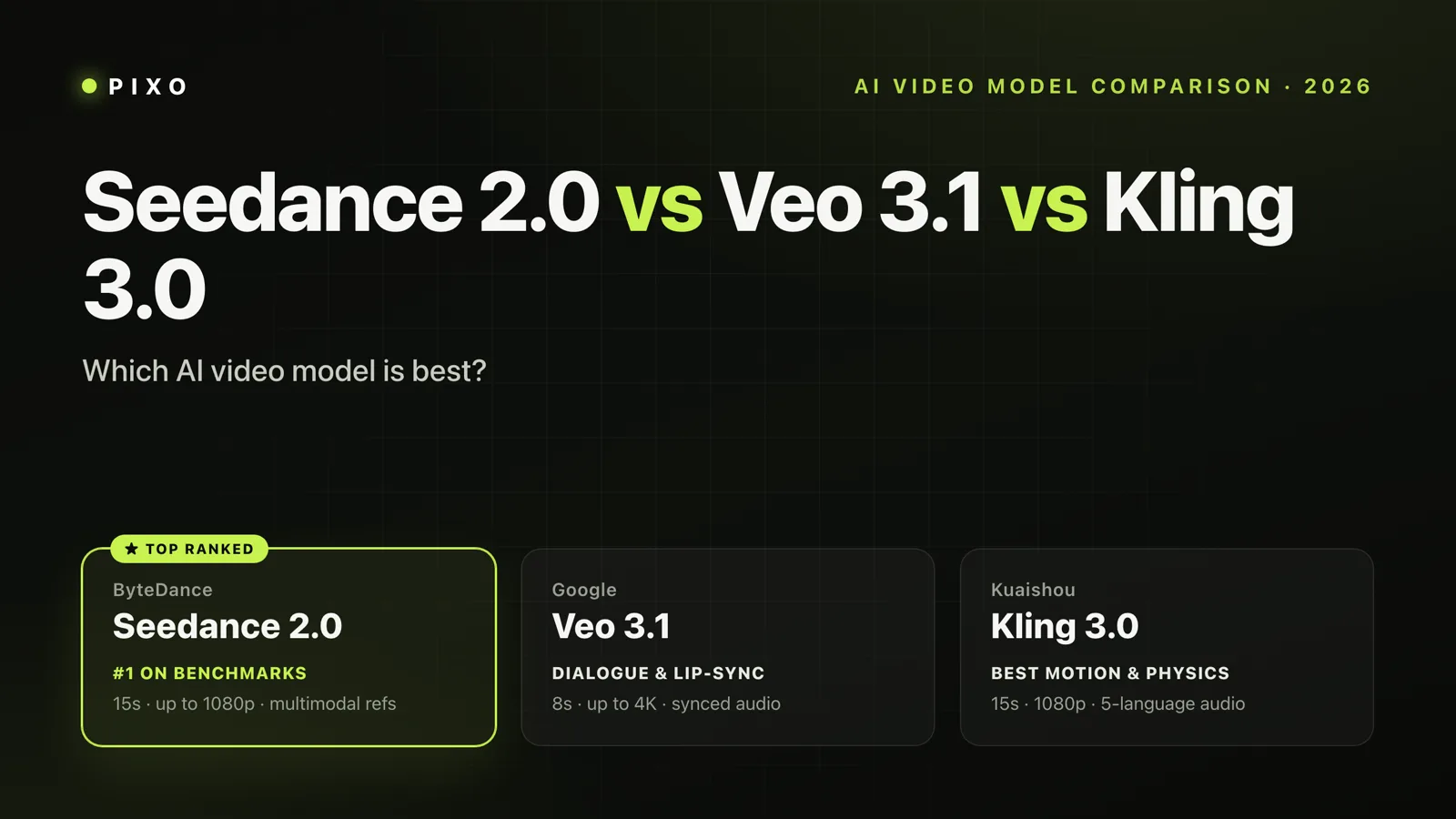
The AI video race in 2026 has three clear frontrunners: Seedance 2.0 from ByteDance, Veo 3.1 from Google, and Kling 3.0 from Kuaishou. They're close enough that "which is best" has become the field's most-asked question, and the honest answer is that it changes shot to shot.
This is a hands-on comparison across what decides real footage: output quality, native audio, motion, clip length, and price. At the end there's a clear pick for each kind of shot.
The Verdict, Up Front
If you just want the answer:
| If you need… | Reach for |
|---|---|
| The best all-round quality | Seedance 2.0 (tops the benchmarks) |
| The most realistic motion & physics | Kling 3.0 |
| Dialogue & reliable lip-sync | Veo 3.1 |
| Precise control from references | Seedance 2.0 (9 images + 3 videos + 3 audio) |
| Longest single clips | Seedance 2.0 / Kling 3.0 (15s) |
As of June 2026, Seedance 2.0 ranks #1 on both the Artificial Analysis text-to-video and image-to-video leaderboards (the default, audio-included view) — the closest thing the field has to an independent scoreboard. Veo 3.1 and Kling 3.0 sit further down it, but each wins specific categories outright, so the right pick stays task-dependent.
Specs at a Glance
| Seedance 2.0 | Veo 3.1 | Kling 3.0 | |
|---|---|---|---|
| Maker | ByteDance | Kuaishou | |
| Max clip length | 15s | 8s (extendable) | 15s |
| Max resolution | up to 1080p | 720p / 1080p / 4K | 720p / 1080p |
| Native audio | Yes, one pass | Yes, synced | Yes, 5 languages |
| Reference inputs | 9 images + 3 videos + 3 audio | Up to 3 reference images | Image + reference-to-video |
| Artificial Analysis rank | #1 (text & image-to-video) | ~#9 text / #6 image | ~#4 text-to-video |
| Pricing | Usage-based | Usage-based (~$0.40/sec, Standard tier) | Subscription + API |
| Access | Dreamina, Volcano Engine API, or Pixo | Google Flow, Gemini API, or Pixo | Kling app, API, or Pixo |
Inside Pixo, all three are billed in unified credits, so you don't juggle three separate API bills or subscriptions. The raw economics above still matter when you decide which model to spend on for a given project.
Seedance 2.0 — The All-Rounder
Seedance 2.0 is the model to beat. It tops the independent benchmarks on the strength of strong prompt adherence, clean motion, and director-level camera control, all in clips up to 15 seconds.
Its standout feature is multimodal reference fusion. You can feed a single generation up to 9 images, 3 video clips, and 3 audio tracks — the deepest compositional control of any model here. Lock a character's face, a location, a motion reference, and a voice, then generate a shot that respects all of them. It also produces dialogue, sound effects, and music natively in one pass.
The trade-offs: physics realism still trails Sora 2 in edge cases, and the 15-second cap means longer sequences get assembled shot-by-shot. One asterisk on the benchmark crown: on the niche audio-off text-to-video board it ranks third, behind Alibaba's HappyHorse — on every other view it leads.
Best for: overall quality, character and scene consistency from references, and complex shots that need tight control.

Create AI videos with Pixo
Turn any idea into a publish-worthy video. One sentence is all it takes.
Veo 3.1 — The Dialogue Specialist
Veo 3.1 is Google's flagship, and its calling card is sound. Audio is generated natively in the same call and synced to the on-screen action, which makes it the safe choice for anything where speech carries the scene. Prompt adherence is excellent, and Google says identity consistency is meaningfully better than Veo 3.
It supports up to three reference images (Google calls them "ingredients"), first-and-last-frame interpolation, native vertical 9:16, and up to 4K output. On the Gemini API its Standard tier runs about $0.40/sec for 720p and 1080p, with cheaper Fast and Lite tiers below that.
The main limitation is duration. Base clips cap at 8 seconds, the shortest of the three, and you go longer by extending and stitching scenes. Reviewers also note some character drift across long extended sequences.
Best for: talking-head and dialogue-driven shots, and anything where tight prompt-following matters.
Kling 3.0 — The Motion & Physics Leader
Kling 3.0 launched in February 2026 (a faster "Turbo" variant has since followed) and it's the model creators reach for when motion realism is the priority — fluid, physically plausible movement that holds up under scrutiny. It runs 15-second clips at up to 1080p, supports native dialogue in five languages, and its Omni mode adds multi-shot storyboard generation.
Where it slips: under heavy motion it can trade away some prompt adherence, and you'll occasionally see micro-detail glitches (fingers, fast-moving fluids) or character drift across regenerations.
Best for: action, dynamic camera moves, dance and sports, and any shot where believable motion comes first.
Which Should You Use?
Match the model to the shot:
- A cinematic establishing shot with a specific character and location? Seedance 2.0, driven by image references.
- A spokesperson or dialogue scene? Veo 3.1, for the synced speech.
- A high-energy action or sports clip? Kling 3.0, for the motion.
- Not sure? Run one prompt through all three and compare the results.
You Don't Have to Choose: Compare Them in Pixo
Subscribing to three separate tools just to find the best model for each shot is slow and expensive. Pixo runs Seedance 2.0, Veo 3.1, and Kling 3.0 — plus Sora 2, Hailuo, WAN, and more — in one workspace.
So you can generate the same prompt across models, compare up to four side by side, and keep the best result for each shot, without leaving your project or paying three bills. Pixo's AI Director can even auto-select the best-fit model per scene; our multi-model generation guide shows how.
The best AI video model isn't a single model. It's the right one for the shot in front of you, and the fastest way to find it is to run them head to head.
Start comparing models in Pixo — free daily credits included. New to AI video? Begin with our getting-started tutorial.
Frequently Asked Questions
Which is the best AI video model in 2026?
As of June 2026, Seedance 2.0 tops Artificial Analysis's text-to-video and image-to-video leaderboards (the default, audio-included view). But Kling 3.0 wins on motion and physics and Veo 3.1 owns dialogue scenes, so the best model depends on the shot.
Is Seedance better than Veo and Kling?
On overall benchmark quality, yes: Seedance 2.0 currently ranks first. Veo 3.1 is the better choice for audio-driven scenes and Kling 3.0 for realistic motion, so "better" is task-specific.
Which AI video model has the best audio?
It's close, since all three generate audio natively. Veo 3.1 is the go-to for reliable dialogue lip-sync, Seedance 2.0 rates highest on the blind audio-included benchmark, and Kling 3.0 handles dialogue in five languages.
Can I use all three in one tool?
Yes. Pixo runs Seedance 2.0, Veo 3.1, and Kling 3.0 (plus many more) in one workspace, so you can compare them on the same prompt and pick the best per shot.
Generate AI summary
From idea to finished video.
In one conversation.
Start CreatingNo credit card required • Free 200 credits