Design a Post-Apocalyptic Wasteland
Build a survival landscape from resource scarcity, repaired materials, harsh sunlight, and airborne dust, then follow one purposeful movement through the ruins.
Best for: survival stories · vehicle scenes · game and film concepts
What defines the look
Composition
Use a broad desolate landscape with one readable route, a human-scale survival task, and a large damaged landmark.
Color
Combine bleached earth, rust red, faded canvas, charcoal rubber, and a small functional color marker.
Light
Use hard high sun, sharp contact shadows, heat haze, and dusty atmospheric depth.
Material
Show repaired metal, cracked concrete, frayed canvas, rope, scratched solar panels, and sand-worn plastic.
Motion
Follow one practical action at moderate speed. Dust and fabric should respond to one consistent wind direction.
Build the key image
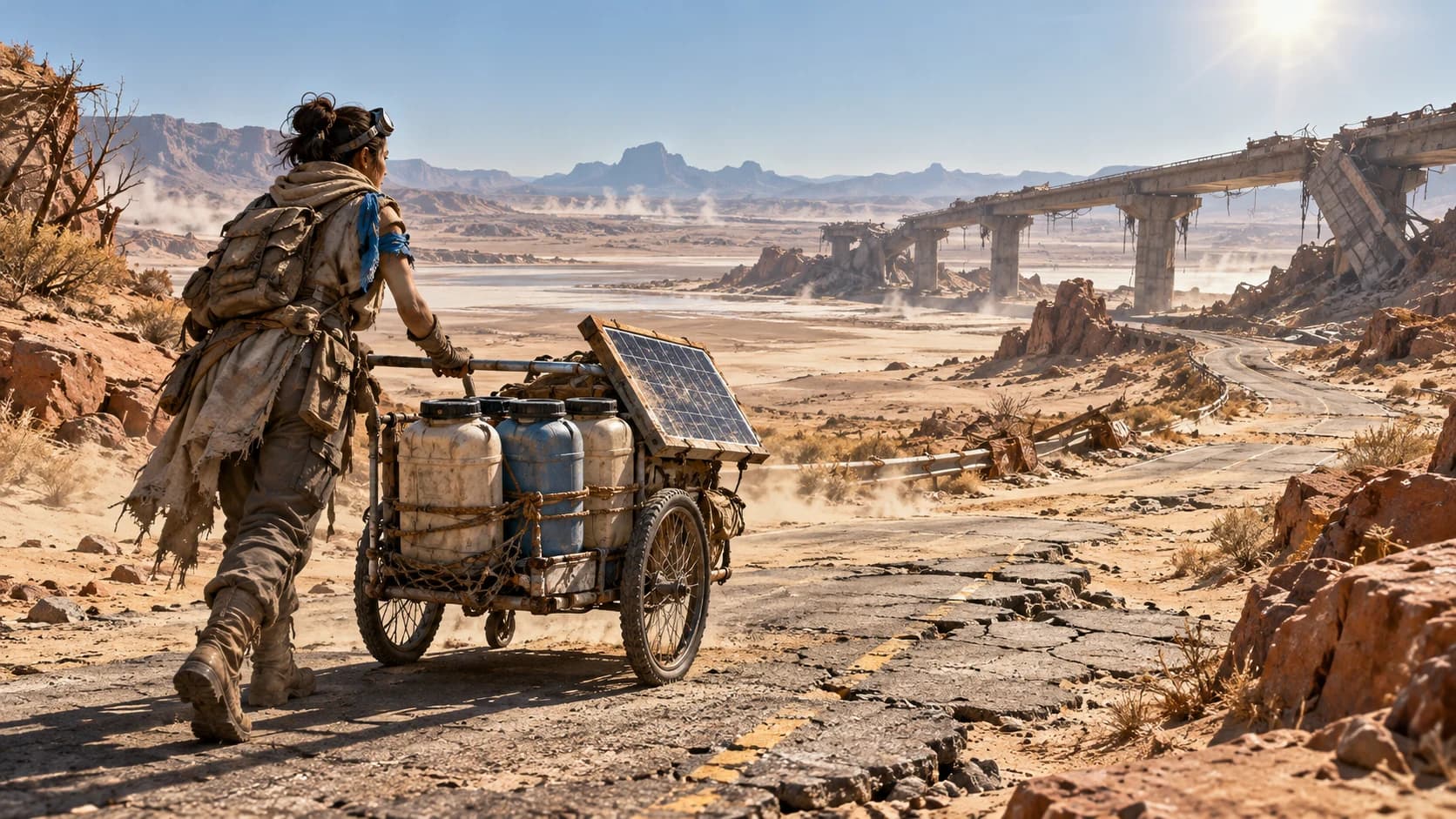
An original post-apocalyptic survival scene featuring a lone water scout pushing a hand-built solar cart along a fractured service road in a dry basin. The scout wears layered faded canvas, protective goggles resting above the eyes, and a blue cloth marker tied to one shoulder. The cart has two bicycle wheels, patched aluminum tubing, three sealed water containers, and one scratched rectangular solar panel, all physically plausible and clearly visible. Wide 16:9 landscape composition with a collapsed concrete overpass in the distance, an open route through the frame, and no modern city skyline. Blistering high sunlight, hard contact shadows, heat haze, and suspended dust. Bleached earth, rust red, faded tan, charcoal rubber, and one blue accent. Weathered metal, cracked concrete, frayed fabric, rope, and sand-worn plastic. No weapons, skulls, logos, text, crowds, or recognizable franchise vehicles.Bring it into motion
Use the supplied water-scout wasteland image as the exact visual reference and first frame. The camera tracks parallel to the scout at a steady walking pace while the scout pushes the solar cart forward along the existing road. Both wheels rotate consistently and all three water containers remain secured. One gust of dust crosses behind the cart from right to left, lifting the blue shoulder marker and one canvas edge before they settle. Preserve the scout's face, clothing, goggles, cart frame, wheel count, solar panel, containers, overpass, road, sun direction, hard shadows, and rust-earth palette. No cuts, vehicle acceleration, combat, new people, changing supplies, collapsing structures, wheel distortion, or camera orbit.Use this look for
A high-speed wasteland shot
Design a separate vehicle asset with a fixed silhouette before attempting speed; do not combine it with the walking hero shot.
A survival product story
Show one rugged tool performing a clear function among repaired materials while keeping product geometry accurate.
Adjust the result
- The scene becomes costume fantasy: Add a concrete survival task and physically plausible repairs rather than random spikes and accessories.
- Dust hides important details: Keep the main gust behind the subject and reduce foreground opacity.
- The cart changes during motion: State wheel count, frame, panel, and container positions and limit camera travel.
Generation details
- Image model
- OpenAI ImageGen
- Video model
- Seedance 2.0 via BytePlus Ark
- Image reference used
- The key image shown above
- Aspect ratio
- 16:9
- Video duration
- 6.04 seconds
- Generation date
- 2026-10-19
- Selected output notes
- The cart and survival gear stay recognizable; dust and cloth movement carry the action.
FAQ
Does post-apocalyptic imagery require combat?
No. Scarcity, repair, weather, abandoned infrastructure, and everyday survival tasks can establish the world.
How is this different from Epic Sci-Fi?
Post-apocalyptic scenes emphasize human-scale survival and weathered reuse; Epic Sci-Fi focuses on monumental future architecture and solemn scale.
Can I create a vehicle chase?
Yes, but generate and approve the vehicle design first, then use a separate shot with controlled speed and camera placement.
Why avoid random scrap details?
Functional, explainable repairs make the environment more coherent and help objects remain consistent through motion.
Create your own wasteland scene
Adapt the image and motion prompts to your survival story, then continue the scene in Pixo.