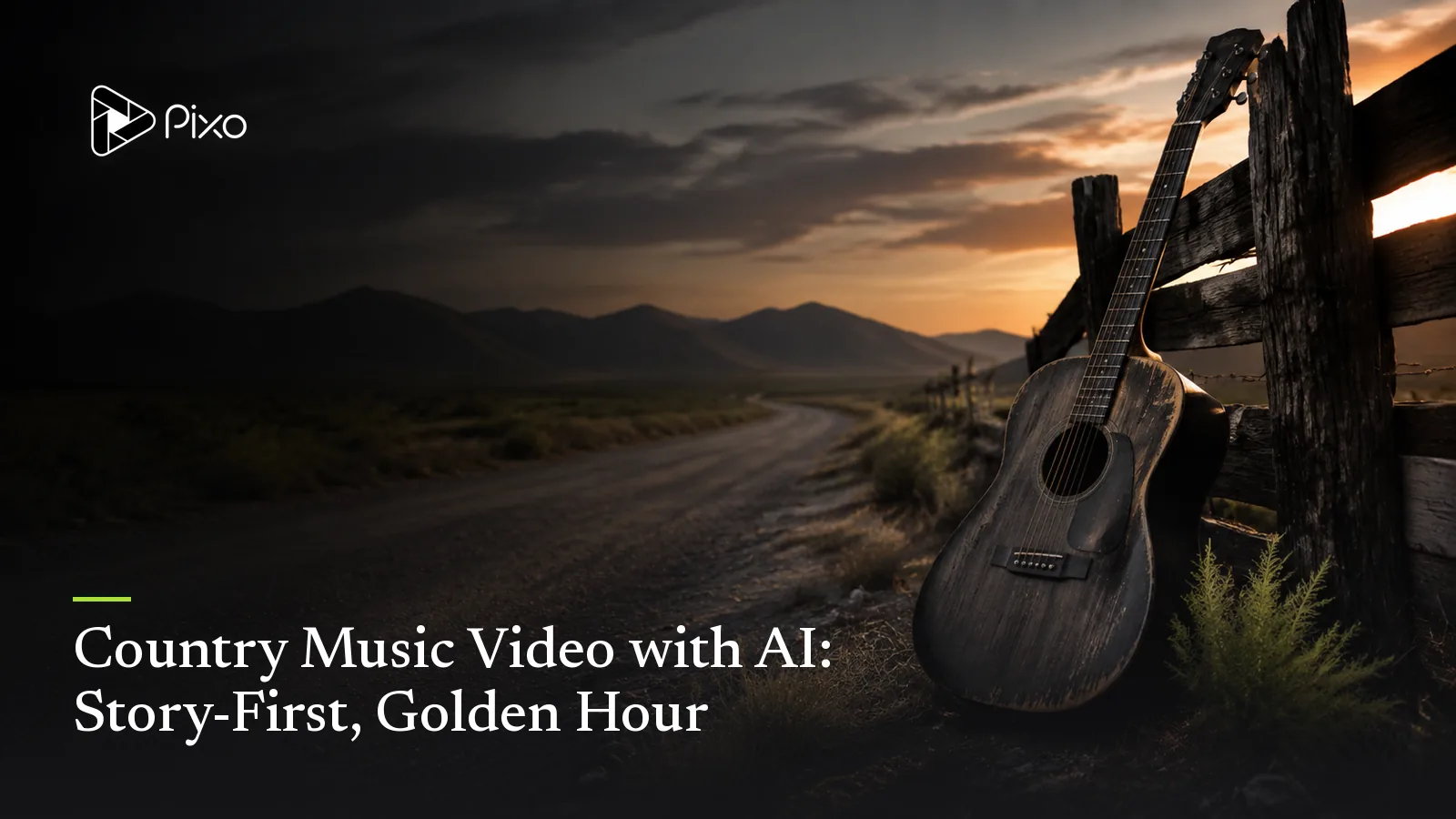
Country Music Video with AI: Story-First, Golden Hour
Country songs are three-minute films — make the video match. How AI turns a story song into a narrative music video: workflow, worked example and prompts.

Country is the storytelling genre. A three-minute country song has a protagonist, a turn, and a last line that recontextualizes everything before it — which means a country music video isn't decoration, it's an adaptation. And adaptations are expensive: actors, a truck, a farmhouse, weather, period detail. The genre whose songs most deserve films has been the genre least able to afford them.
That's the specific gap Pixo's MV Director closes, because its core mechanic — parsing the lyrics and boarding shots around lyric phrases — is literally adaptation. Tell the agent which lyrical images should appear literally and which should stay metaphorical. Here's the workflow, tuned to the genre.
Why Country Maps So Well
The lyrics are the screenplay. MV Director reads lyric structure and timestamps and slices the song into segments — one shot each. In a genre where every line advances a plot, the chunk timing supports the storyboard; the creative brief determines how literally to interpret the words.
Two characters, one film. Country stories run on a couple, a parent and child, a stranger at the bar. Each locks as a reference asset before generation, to help the same faces carry verse one to the final chorus; check for drift — the continuity a narrative video lives or dies on.
The places are characters too. The porch, the F-150, the county line sign — lock them as scene assets and they recur the way the song's images recur. (The porch across seasons and truck's-eye ballad concepts in the music video ideas list were written for this genre.)
Restraint reads right. Country cutting is patient — long takes, golden hour, motion that breathes with a ballad. The camera plan follows the song's energy, and in this genre that means it mostly holds still and lets the light work.
The Workflow
- The song. Upload your recording — or explicitly request song generation, paste lyrics with structure tags and describe the sound ("classic country ballad, pedal steel, fiddle, warm male vocal"); the agent generates it via Suno and you approve the track first.
- Cast and place. Two or three character descriptions, two or three locations — each locks as a reference asset.
- One-sentence spine. "He's selling the farm; the last verse is why he can't." The lyric structure paces it from there.
- Approve the board, generate. Shot plan first, then render: shots align to the track, audio-guided sung-to-camera performance to review, assembled on one timeline.
A Worked Example
Take a verse and chorus:
[Verse]
The auction sign went up today where Daddy taught me how to drive
Forty acres and a mortgage — some things don't survive
[Chorus]
But the radio still works in that rusted Chevrolet
So I sit out here at sundown, and I drive it anyway
The board writes itself because the song already did: verse — a slow push past an AUCTION sign at the fence line, morning fog; cut to weathered hands on a steering wheel, a memory-flash of the same wheel with a kid's hands on it; chorus — golden hour, the rusted Chevy in tall grass, dashboard radio glowing, the man sitting in the driver's seat going nowhere, dust hanging in the last light. Second chorus: same shot, later light, the field now empty around the truck. The repetition is the meaning — same frame, world changing around it.
Tips and Pitfalls
- Cast the ending first. Country songs earn their last line; decide what image lands it (the empty porch, the lights coming on, the letter unfolded) and let the agent build backwards from it.
- Season and light do the emotional work. Ask for light changes across choruses — noon to golden hour to dusk — before adding any plot.
- Keep the Americana practical. Diner neon, gravel dust, a screen door — texture beats spectacle in this genre every time.
- If the singer appears, keep it honest: one location performance (porch, barn, honky-tonk stage) intercut with the story, not green-screen glamour.
Review Before Release
These prompts are starting briefs, not verified sample outputs. Reference images help continuity; they do not guarantee identical faces, exact lettering, choreography or seamless loops. Review the full cut, including vocal close-ups and repeated shots. Ask explicitly for song generation and provide lyrics if using Suno; approve the audio first. Video generation has a separate approval checkpoint. Song and image generation and requested retries can consume credits before that checkpoint. Check current pricing for your settings.
Turn a Story Song into a Shot Plan
Mark three things in the lyrics: what happens, what changes emotionally, and which objects recur. Map those to the available storyboard panels. A letter can appear unopened in the first verse and folded beside an empty chair at the end; it does not need readable generated handwriting. Review the ending first, then check whether the earlier shots establish what it means.

Create AI videos with Pixo
Turn any idea into a publish-worthy video. One sentence is all it takes.
Music-video release checks
For a music release, distinguish the composition from the recording using the U.S. Copyright Office's musician guidance. For a YouTube delivery, compare the export with YouTube's encoding recommendations. Before publishing realistic generated scenes, check YouTube's AI disclosure guidance for the upload decision.
FAQ
Can AI make a country music video?
Yes. A story song offers a useful starting point for a narrative brief. Pixo's MV Director parses the lyrics and timestamps, boards a narrative shot for each timed lyric chunk, and renders the video aligned to the track with audio-guided vocal performance to review.
What makes a good country music video?
The song's story, told straight: characters you believe, places that feel lived-in (trucks, porches, county roads, honky-tonks), and an ending that lands the last chorus. Golden-hour light and practical Americana detail do more than any effect.
Can the video follow my song's actual story?
Ask for a narrative adaptation, identify the key lyric images, and review how the storyboard interprets them. Image references guide recurring characters and locations, but generated continuity still needs review.
Do I need to be in the video?
No. Cast generated characters — a couple, a farmer, a bartender — or make a performance video with a locked artist. Many story songs work best when the singer never appears.
Do I need the song recorded first?
No — explicitly request song generation, write the lyrics with structure tags, describe the sound ('classic country ballad, pedal steel, warm male vocal'), and the agent generates the track via Suno for your approval before boarding the video.
Your song already wrote the film — Pixo's MV Director shoots it. Sign up now. See the current plans and generation costs before starting. Full pipeline in the AI music video guide; writing from lyrics alone? See the Suno music video guide.
Generate AI summary
From idea to finished video.
In one conversation.
Start CreatingNo credit card required • Free 200 credits