8 Halloween Product Ad Examples to Adapt
Explore eight original Halloween product ad examples built around demonstrations, offers, reveals, bundles, retargeting, and seasonal stories you can adapt.

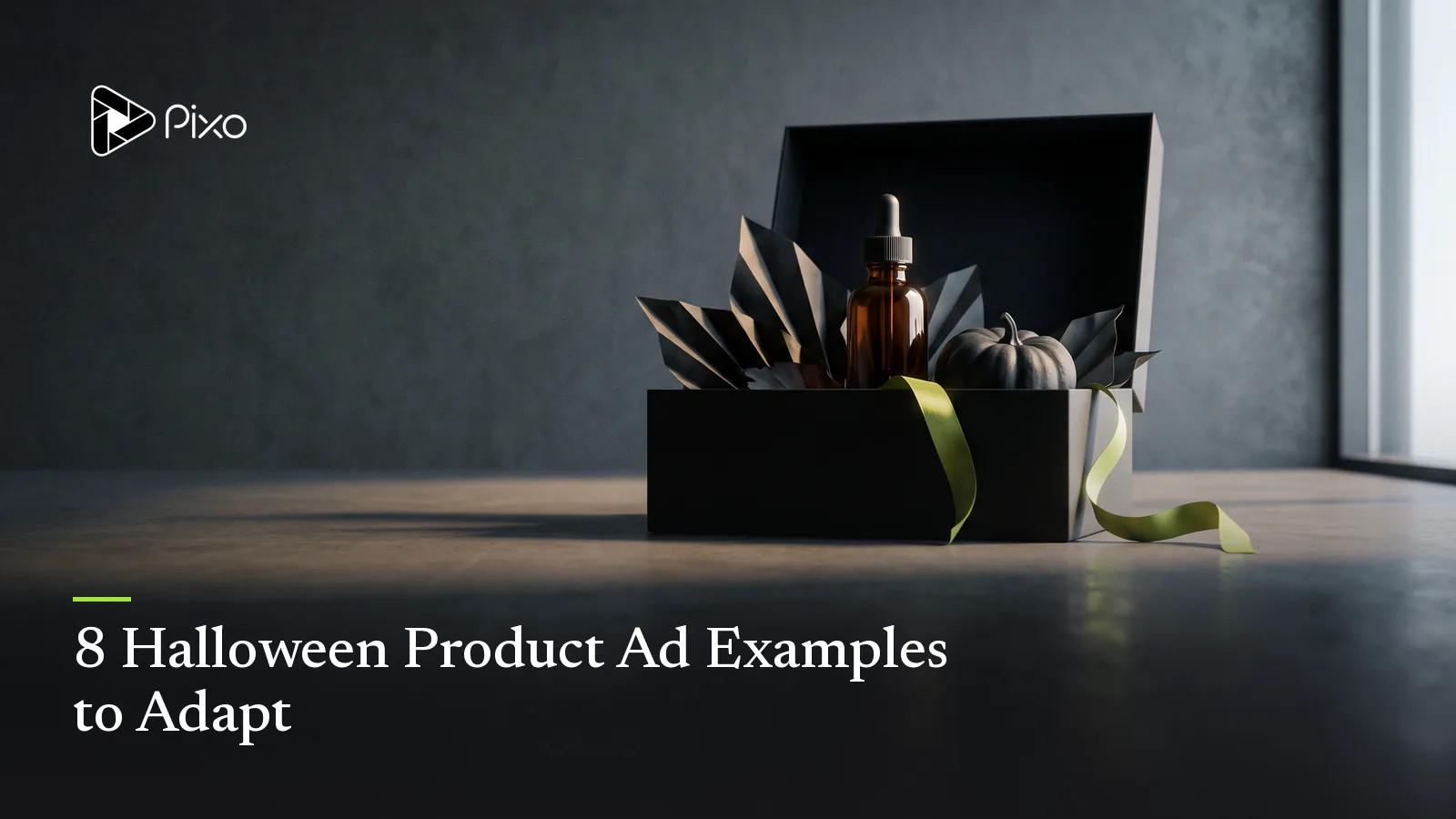
A product ad does not become seasonal because a pumpkin sits beside the box. Halloween creative works when mystery, transformation, costume, ritual, or anticipation helps demonstrate something true about the offer.
The eight examples below are original advertising structures, not copied campaigns. Each starts from a different commercial job and explains what the Halloween device contributes. Adapt the premise to an approved product reference, supported claim, actual offer, and real CTA.
For the surrounding campaign, see the Halloween marketing ideas. For ready-to-adapt visual directions, use the Halloween AI video prompts.
Halloween product ad examples at a glance
| Example | Product job | Halloween device | CTA |
|---|---|---|---|
| The problem that returns | Demonstrate a solution | Recurring “ghost” problem | See how it works |
| Midnight unboxing | Reveal product and packaging | Box opens at midnight | Shop the edition |
| Two-mode transformation | Show product versatility | Day-to-night change | Explore both modes |
| Host kit ritual | Sell a bundle | Table assembles itself | Get the set |
| Costume-ready proof | Demonstrate practical benefit | Preparation sequence | Shop or book |
| Mystery flavor reveal | Launch a seasonal item | Clue-led reveal | Try the release |
| Abandoned-cart reminder | Remove one objection | Friendly returning ghost | Continue checkout |
| After-Halloween value | Extend product relevance | Decor disappears, use remains | Keep using it |
1. The problem that keeps returning
Use when: the product solves a visible, recurring frustration.
Open on a tangled desk cable. The user organizes it, leaves frame, and the cable mysteriously returns. Repeat once, then let the product solve the problem in a clear demonstration.
The “haunting” gives repetition a reason. The ad still needs to show exactly how the organizer works; otherwise the seasonal joke replaces the proof.
2. Midnight product unboxing
Use when: packaging, finish, or a limited edition is part of the value.
A clock reaches midnight. A matte box opens through a controlled sequence, revealing the authorized product under a warm orange rim light. Close details show the real material and included components before the CTA.
Use approved product and packaging references. Add exact labels, price, availability, and legal copy in the final edit if generation cannot preserve them reliably.
3. Day mode versus night mode
Use when: the product has two genuine uses, settings, or configurations.
Show the product solving a normal daytime task. The environment transitions into a Halloween evening while the same item changes to its second supported mode. A lamp moves from focused work light to warm ambient light; a bag shifts from commute organization to event carry.
Match the camera and product position across the transformation so the comparison remains credible.
4. The self-assembling host kit
Use when: several products form one purposeful bundle.
Begin on an empty table. Each component enters in sequence: serving item, drink, decoration, activity, then the full hosting setup. Give every item a readable moment before the final composition.
State exactly what the customer receives. Generated atmosphere should not add products that are absent from the bundle.
5. Costume-ready demonstration
Use when: the product supports makeup, clothing, accessories, photography, events, or preparation.
Follow one person through a concise preparation sequence: starting point, one product action, finished original look, and real-world movement check. The benefit should be observable rather than expressed through an unsupported superlative.
Use a permitted likeness and original costume concept. Do not imply an AI visualization proves real fit, cosmetic safety, or durability.
6. Mystery flavor or variant reveal
Use when: the campaign has a real new product, flavor, color, or feature.
Release three clues that narrow the answer, then reveal the product before the CTA. A bakery might show color, ingredient, and texture. A software product might reveal a seasonal template through three interface details.
The mystery needs enough context that the audience knows what category of value is being teased. Verify all ingredients, compatibility, and availability.
7. Friendly abandoned-interest reminder
Use when: the audience has already viewed or saved a product.
Return to the exact item and answer one likely objection: delivery timing, fit, setup, what is included, or return policy. A tiny friendly ghost can carry the unanswered question into frame, but the response must come from approved information.
Avoid language that pretends the creative knows private behavior. Let campaign targeting handle the audience signal.
8. The product after Halloween
Use when: seasonal presentation could make an evergreen product look disposable.
Open on the Halloween use, then let the decorations leave the frame while the product continues solving an ordinary problem. The final message is not “Halloween is over”; it is “the reason to own this remains.”
This structure is useful for apparel, home products, software, food tools, cameras, lighting, and services whose value continues beyond October.
Turn one example into a storyboard
Start with the product, one supported promise, available proof, audience, and CTA. The Agent can propose the hook and scene sequence from that simple direction. Add duration, channel, exact copy, references, and constraints when they are already known.
The AI Product Advertisement Video Maker connects an approved product reference to a planned demonstration. The AI Video Ad Maker is the broader path for an offer, proof point, and variation plan. For campaign sequencing beyond one ad, use the Halloween marketing ideas.
Review the ad before generating variants
Check that the product appears early enough, the benefit remains visible without the Halloween decoration, and the CTA matches the landing destination. Confirm product shape, materials, packaging, included items, price, dates, availability, claims, and any required disclosure.
Create variants around a hypothesis. Change the hook while preserving the demonstration, or change the proof point while preserving the offer. If every element changes, the campaign cannot explain which decision mattered.

Create AI videos with Pixo
Turn any idea into a publish-worthy video. One sentence is all it takes.
FAQ
What makes a Halloween product ad effective?
The seasonal device should make the product benefit, offer, demonstration, or audience problem easier to understand rather than hiding it behind decoration.
Can any product use Halloween advertising?
A product does not need a Halloween edition, but it needs a relevant seasonal angle such as hosting, costume preparation, autumn use, mystery, transformation, or a real deadline.
Should a Halloween ad copy a famous horror movie?
No. Build an original premise, character, setting, and visual system instead of imitating protected characters, logos, music, scenes, or a living artist’s style.
How many messages should one Halloween product ad contain?
Use one main product promise and one primary action. Supporting scenes can provide proof without introducing unrelated benefits or competing CTAs.
Build the seasonal idea around the product truth
Give Pixo the product and one campaign direction. Review the proposed ad structure and references before generating scenes, then keep exact commercial copy under controlled editorial review.
Generate AI summary
From idea to finished video.
In one conversation.
Start CreatingNo credit card required • Free 200 credits