Rap Music Video with AI: Night Cities, Flow-Cut Editing
Make a rap or hip-hop music video with AI: night-city worlds, cuts that follow the flow, and a locked artist across every shot. Workflow, prompts and tips.

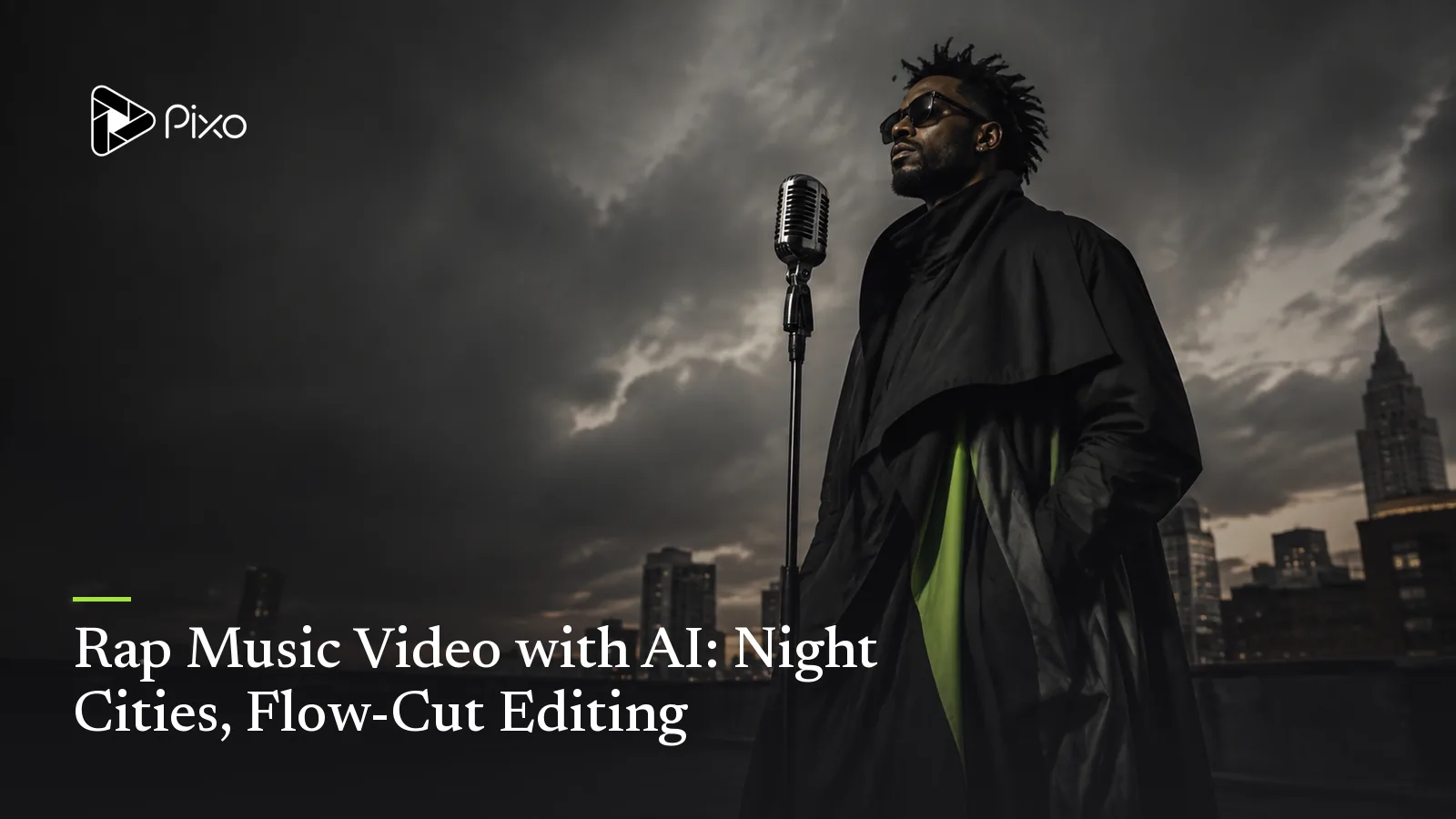
Hip-hop invented the low-budget music video as an art form — one block, one crew, one night, and an edit that turns limitation into style. But even the leanest shoot has a floor: a camera, a night, favors called in. And the genre's visual ambitions stopped being low-budget years ago; the videos that travel now bend cities, stack eras and drown sets in water, which is exactly the stuff nobody's cousin can shoot.
An AI workflow can explore scenes beyond the locations available for a shoot, with generation costs and revision time to budget. Pixo's MV Director generates the video from the track itself — the artist locked as a reference, the world built to order, and the editing following the flow, which in this genre is the entire game.
The Cut Follows the Flow
Rap editing has a rule the other genres don't: the cut answers the cadence. Double-time delivery wants strobing b-roll; a laid-back verse wants one long dolly past the block; the hook wants the artist's face, dead center, every time it returns.
MV Director gets there structurally: it parses the track's structure and timestamps, slices it into segments — one shot each — and matches camera energy to each section. Denser flow, denser cutting; the hook comes back, the framing comes home. And because shots auto-align to the vocal with audio-guided vocal performance, review the to-camera bars for mouth-timing errors.
The genre's practical trick survives translation: carry hooks on lip-synced close-ups and let verses ride on world shots — the block, the car, the hands. It's how real hip-hop videos handle fast delivery, and it's one instruction here.
Worlds the Genre Owns
Lock one register as your style reference and stay in it:
- Night sodium — wet asphalt, streetlight orange against neon, long lens across the block.
- Fisheye energy — the Hype-Williams-era front lens, artist filling frame, ceiling curving away.
- VHS-era — camcorder grain, timestamp corner, whip pans; the throwback that always reads.
- Blacked-out studio — one key light, smoke, silhouette bars; the cheapest look in real life and still the toughest.
- Documentary daylight — flat honest light on real streets, handheld, no glamour: the counter-programming choice.
The Workflow
- The track. Upload the MP3 — or explicitly request song generation, write the bars in the chat with structure tags, describe the beat ("dark trap, 140 BPM, heavy 808s, male voice"), and the agent generates it via Suno for your approval first.
- The artist. One description locks the lead as a reference asset: face, chains, fits — compare these details between shots, because references do not guarantee identical results. Add the car or the crew as additional locked assets if they recur.
- The world. One register from the list above, one sentence.
- Approve and render. Storyboard plan comes to you first; then shots generate, align to the vocal, and assemble on one timeline.
A Starter Board
Artist: locked reference — black hoodie, silver chain, clean white lows. World: night sodium; the block, a corner store, one parked '87 Buick. Verses: long tracking shots past the block, artist walking through, world shots carrying the pace. Hook: dead-center close-up under the streetlight, lip-synced, same framing every return. Bridge: rain starts; everything slows to half-speed; the Buick's lights come on. Final hook: same close-up, now in the rain.
The discipline in that board — same framing every return — is what makes a rap video feel authored instead of generated.
Tips and Pitfalls
- Anchor with recurring objects. The car, the corner, the chain: hip-hop videos are built on totems, and locked reference assets are literal totems.
- Escalate weather, not location. Staying on one block while the night changes reads more expensive than teleporting between ten sets.
- Don't chase real artists' likenesses. Original artist, original chain — identity rights are the AMV-footage problem of this genre.
- The 90s throwback and era-stack concepts (same corner, three decades) from the music video ideas list were built for this genre — steal them.
Review Before Release
These prompts are starting briefs, not verified sample outputs. Reference images help continuity; they do not guarantee identical faces, exact lettering, choreography or seamless loops. Review the full cut, including vocal close-ups and repeated shots. Ask explicitly for song generation and provide lyrics if using Suno; approve the audio first. Video generation has a separate approval checkpoint. Song and image generation and requested retries can consume credits before that checkpoint. Check current pricing for your settings.
Plan Coverage for Fast Bars
The rap video workflow is a starting point for the full cut. For passages carried by the artist on camera, use the performance-video workflow to separate those shots from the environment coverage.
Mark the phrases that need the performer visible and those that can play over environment shots. Review a complete fast-vocal panel first. If mouth timing distracts, ask for an offscreen vocal over a street, car or detail shot; do not repeatedly regenerate a close-up without deciding what should improve.

Create AI videos with Pixo
Turn any idea into a publish-worthy video. One sentence is all it takes.
Music-video release checks
For a music release, distinguish the composition from the recording using the U.S. Copyright Office's musician guidance. For a YouTube delivery, compare the export with YouTube's encoding recommendations. Before publishing realistic generated scenes, check YouTube's AI disclosure guidance for the upload decision.
FAQ
Can AI make a rap music video?
Yes. Pixo's MV Director parses the track's structure and timestamps, locks your artist and world as reference assets, and boards shots whose cutting density follows the flow — rendered aligned to the vocal with audio-guided vocal performance.
How does the video follow the flow?
The system slices the track into segments from its structure and timestamps; sections with denser delivery get tighter, faster cutting, while laid-back passages hold longer shots. The energy map comes from your actual recording, not a fixed template.
Does lip-sync work for fast delivery?
Audio guides vocal performance, but fast delivery can expose imperfect mouth timing; inspect the result before accepting it. For very fast passages, the practical trick is the genre's own: intercut performance close-ups with world shots, so the mouth carries the hook lines and the b-roll carries the verses' pace.
What visual styles work for hip-hop videos?
The classic registers all translate: night-city sodium and neon, fisheye front-lens energy, VHS-era grain, blacked-out studio with a single key light, or documentary daylight on the block. Lock one register as the style reference and commit.
Do I need a finished track first?
No — explicitly request song generation, paste your bars with structure tags and a beat description ('dark trap, 140 BPM, heavy 808s'), and the agent generates the track via Suno for your approval before boarding the video.
Your bars, your block, your video — Pixo's MV Director builds it from the track. Sign up now. See the current plans and generation costs before starting. Full pipeline in the AI music video guide; no beat yet? Start from the Suno music video guide.
Generate AI summary
From idea to finished video.
In one conversation.
Start CreatingNo credit card required • Free 200 credits