How Much Does a Music Video Cost? Budget Tiers for 2026
How much does a music video cost? Compare DIY and production budgets, crew day rates and credit-based AI workflows, with room for revisions.

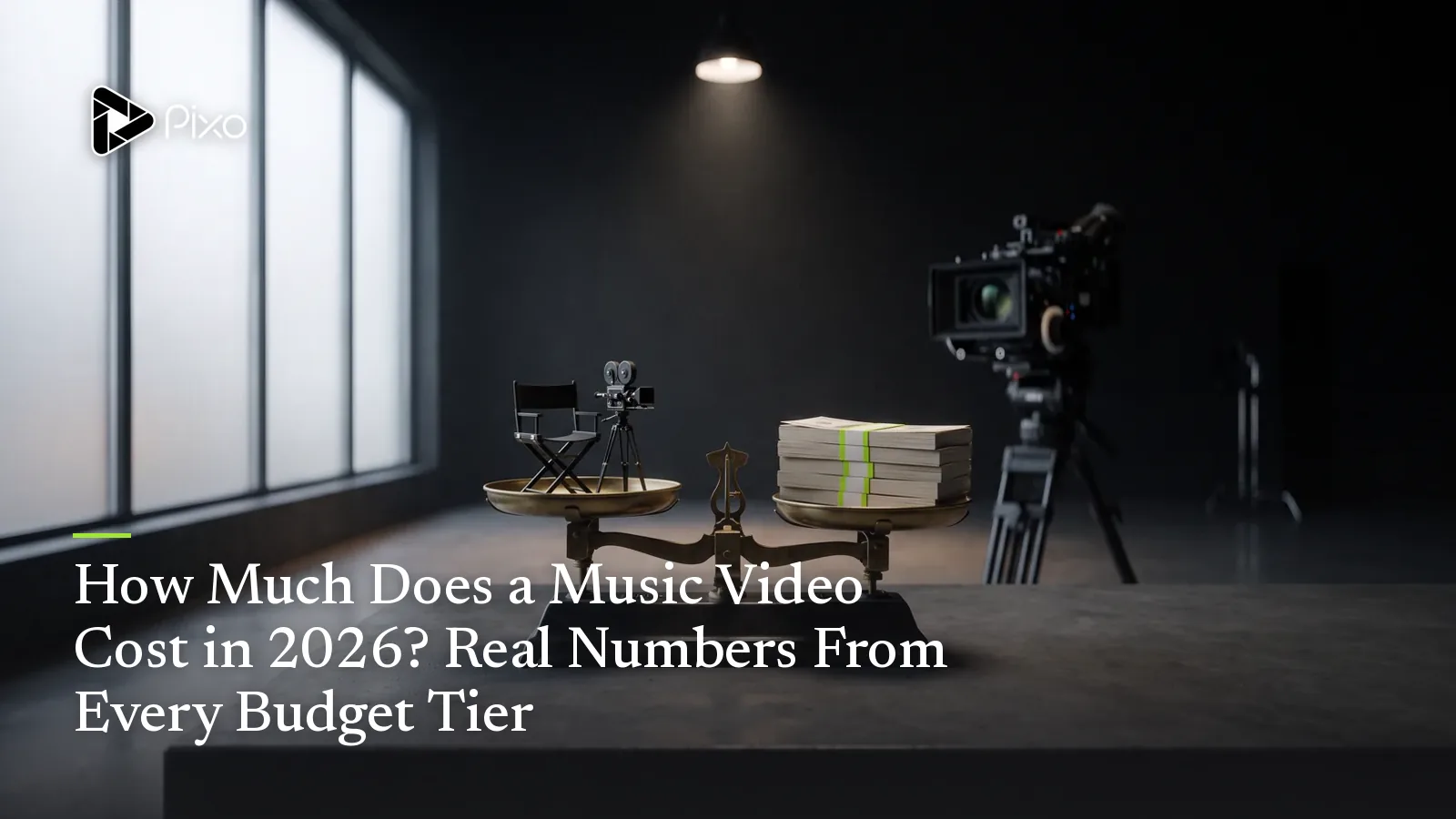
Music video costs depend on the brief. Blare Video’s production guide describes a wide span from small crews to commercial productions. Historical high-budget rankings give context, but they are poor benchmarks for a self-funded release.
This guide compares production budget ranges and the work behind them, then explains how credit-based AI generation changes the line items. These are planning examples, not quotes for your project.
One thing this article won't do is pretend there are only two options. Since 2025, a fourth tier has appeared below DIY on the price ladder — AI music video production — and we'll give it the same honest, itemized treatment as the rest.
Budget an Audio-First AI Workflow
Upload your chosen vocal track, or explicitly ask for song generation with Suno and supply lyrics. Listen and approve the track, develop a treatment, then approve the storyboard before video generation in MV Director. Song and reference-image generation can consume credits before that approval. Reserve budget for retries, alternate aspect ratios and finishing; revising one generated shot does not require a new shoot day, but it is still billable generation.
The Quick Answer: Music Video Costs by Tier
| Tier | Typical cost (2026) | What you get |
|---|---|---|
| AI production | Depends on settings and retries | Full video: storyboard, generated scenes, lip-sync, final cut |
| DIY / guerrilla | $500 – $1,500 | Phone or DSLR, natural light, friends as crew, self-edited |
| Indie professional | $2,000 – $8,000 | Small crew, rented gear, one location, pro edit and color |
| Production company | $10,000 – $50,000 | Full crew, director, production design, multi-location |
| Label / commercial | $100,000 – millions | Everything, plus the invoice that comes with it |
Use these bands as planning ranges, not local quotes. For comparison, Blare Video's 2026 breakdown puts shoestring shoots at $2,000-$5,000 and commercial productions at $50,000-$500,000+, while J. Scalco’s production guide confirm real videos do get made for $500 — just with sharp constraints.
Where the Money Actually Goes
Separate pre-production, the shoot and post-production in your budget. The proportions vary with the concept; ask vendors for an itemized quote.
Crew day rates
People are the biggest cost on any professional shoot. Blare Video lists the following indicative day rates in its April 2026 guide. Actual rates depend on location, crew experience, hours and scope:
| Role | Day rate (2026) |
|---|---|
| Director | $500 – $1,250 |
| Director of photography | $1,000 – $1,800 |
| Production designer | $450 – $2,000 |
| Gaffer (lighting) | $325 – $400 |
| Hair & makeup artist | $325 – $500 |
| Production assistant | $250 – $300 |
A minimal five-person crew — director, DP, gaffer, HMU, one PA — starts around $2,400 for a single shoot day before anyone touches a camera.
Equipment, locations, and permits
Price a complete camera package, including lenses, support and insurance. Add lighting, location hire and any permit fees separately. A camera-body rental price alone is not the cost of a working shoot kit. Confirm current local fees before booking.
Post-production
Budget separately for editing, color, sound finishing and versioned exports. Complexity, footage volume and the number of revision rounds affect the quote. Ask how the editor charges for additional cutdowns or late changes.
Seasoned producers also pad every budget with a 10-15% contingency, because something always goes wrong on a shoot day. When you only have one.

Create AI videos with Pixo
Turn any idea into a publish-worthy video. One sentence is all it takes.
The Four Tiers, Honestly Assessed
DIY ($500 – $1,500): concept is everything
An illustrative small-budget allocation: $500 camera rental, $300 location, $200 props and costumes, $500 editing — $1,500 total. At this tier your phone shoots 4K, your lighting is the sun, and your crew works for pizza. A focused concept can make a small budget more effective. The failure mode isn't cheapness — it's shooting a generic performance video that needed $20,000 of polish to work.
Indie professional ($2,000 – $8,000): the sweet spot with a catch
This buys a skeleton crew, decent glass, one good location, and a proper edit-and-color pass. It's the most common tier for serious independent releases. The catch: at this budget you get one shoot day and no reshoots. If the footage comes back wrong, your options are re-editing around problems or paying again.
Production company ($10,000 – $50,000): you're buying certainty
What the extra money buys isn't just production value — it's risk removal. Treatment development, production design, backup gear, experienced department heads, insurance. For a label with a marketing plan riding on a release date, that certainty is worth it. For an artist self-funding out of streaming revenue that pays fractions of a cent per play, the math rarely closes: you'd need millions of streams to recoup a $15,000 video from streaming alone.
The famous money pit (for perspective)
Large productions may involve name directors, custom sets, choreography and visual effects. Their budgets are poor benchmarks for a self-funded release; price the actual work in your own treatment.
The Fourth Option: AI Music Video Production
Since 2025, AI video generation has matured from "interesting demo" to a genuine production tier — and it restructures the cost table entirely, because it deletes the line items rather than discounting them. No crew day rates, no gear rental, no location fees, a different set of generation and revision costs.
Here's what the workflow looks like on Pixo's AI music video production pipeline: you upload your track as an mp3, the AI director transcribes the lyrics and maps the song's structure, then proposes a scene-by-scene storyboard — effectively a director's treatment you can edit. Each panel generates as a video clip with audio-guided vocal performance that needs a lip-sync review, and the full track is muxed over the final export. A revision isn't a reshoot day; it's regenerating one scene.
Pixo uses credits for generation. Total cost depends on model settings, shot duration, reference assets and requested retries; do not assume a full music video fits inside one monthly allowance. Check the plan and generation estimate in Pixo before committing, then test a short section.
The honest limits: AI production is at its best for narrative, stylized, animated, and performance-driven concepts. If your vision requires you physically on camera in specific real locations, hybrid approaches work better — shoot minimal footage of yourself, and let an AI music video generator produce the world around it. And the budget you save funds the assets a release actually needs in volume: a Spotify Canvas for every track, a lyric video for the fans, vertical cuts for Shorts and Reels.
How to Pick Your Budget
Work backwards from the song, not forwards from ambition:
- The release is a test or part of a steady cadence → AI production or DIY. Ship a visual for every track; save real money for the song that reacts.
- The song is your lead single and you have $2K-$8K that won't hurt to lose → indie professional, and spend disproportionately on the colorist.
- A label or serious marketing budget is involved → production company, with a contingency line and a written treatment.
- You want a video for every song on the album → this was financially impossible at every traditional tier. It's the specific thing AI production makes routine.
Choose the format and spend your release can support. Keep budget for distribution and promotion, and judge the video by its role in your release rather than assuming motion guarantees reach.
Generate AI summary
From idea to finished video.
In one conversation.
Start CreatingNo credit card required • Free 200 credits