Video Production Company vs AI: When to Hire, When Not To
An honest split of what still needs a video production company and what doesn't — with real 2026 cost and timeline numbers, and where AI genuinely falls short.

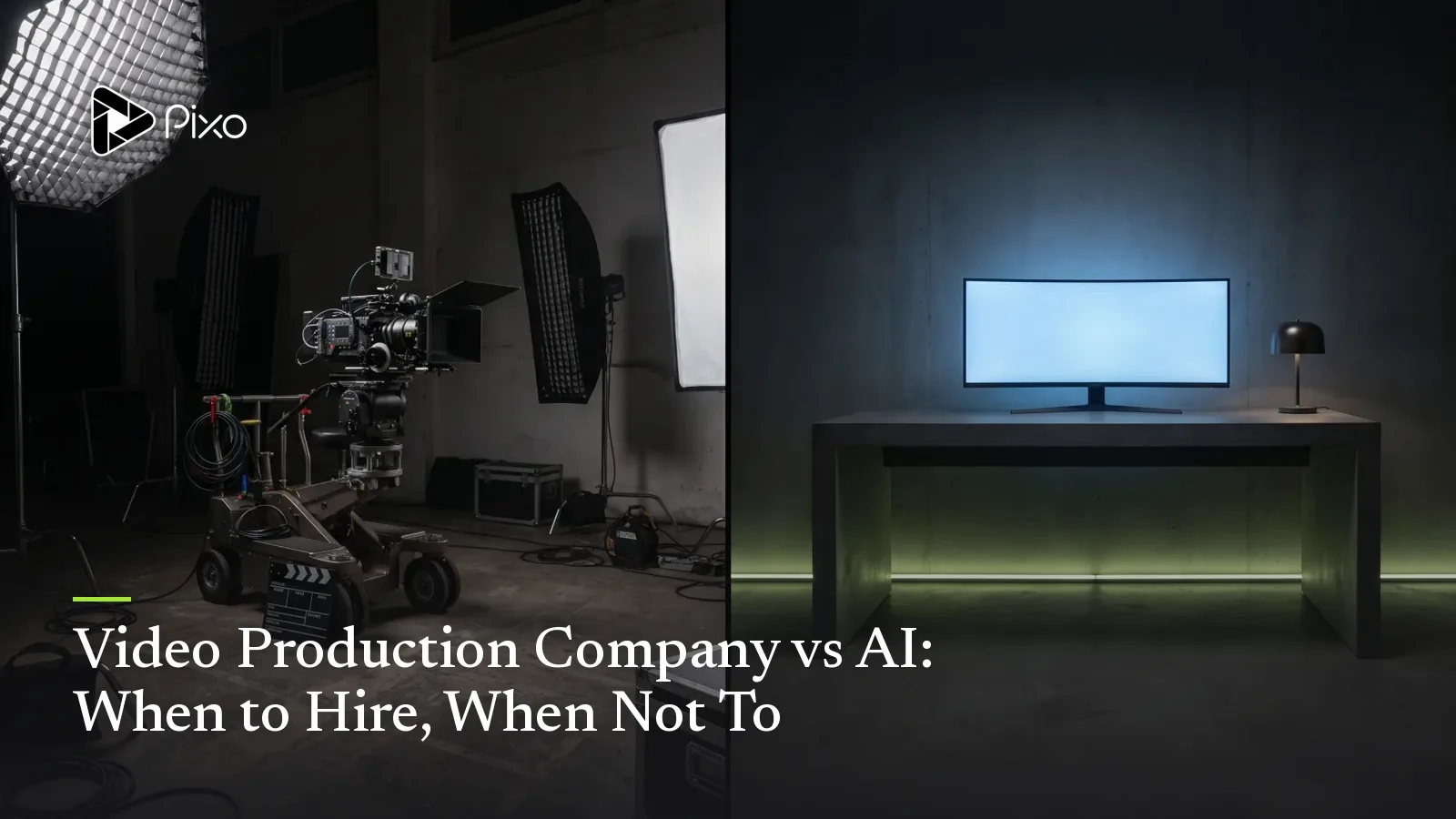
If you're searching for a video production company, you're probably about to spend somewhere between $5,000 and $50,000. Before you do, it's worth being precise about what that money buys — because for some videos it's the only thing that works, and for others it's the most expensive way to get a result you could have had on Tuesday.
This isn't a piece that tells you agencies are obsolete. They aren't, and we'll be specific about where they win. It's a piece about which half of your video budget is well spent and which half is quietly being burned.
The Split, Up Front
| Hire a production company | Do it with AI | |
|---|---|---|
| Real people being themselves | ✅ The only option | ❌ Don't fake this |
| Your physical product, real texture | ✅ | ❌ |
| Live events, interviews, documentary | ✅ | ❌ |
| Licensed talent / celebrity likeness | ✅ | ❌ |
| Hero brand film where craft is the message | ✅ | 🟡 Rising, not there |
| Explainers, tutorials, onboarding | 🟡 Works, overpriced | ✅ |
| Social and ad creative at volume | ❌ Economics don't work | ✅ |
| A/B variants of the same concept | ❌ Each is a new project | ✅ |
| Localized versions | ❌ Reshoot or re-edit | ✅ |
| Anything you'll want to change next month | ❌ | ✅ |
Read the left column honestly. If your video lives there, close this page and hire someone good.
1. What a Production Company Actually Costs
Published 2026 pricing guides put professional production at roughly $1,000 to $5,000 per finished minute. A full commercial typically lands between $10,000 and $50,000+. A corporate or explainer video with a scripted crew shoot runs $4,500 to $20,000 for one to three minutes.
The spread is real, and it's the first thing to understand: a company quoting $1,500 per minute and one quoting $5,000 are usually describing fundamentally different scopes, not competing on price.
But the cost most people misjudge isn't the invoice — it's time. A typical professional project runs 4 to 6 weeks end to end:
| Stage | Duration |
|---|---|
| Pre-production (script, storyboard, scheduling, casting) | 2–8 weeks |
| Shoot | 1–3 days |
| Post-production | 2–4 weeks |
| Revision rounds | +2–4 weeks |
Look at that shoot line. The filming — the part you're picturing when you imagine "making a video" — is one to three days. Everything else is coordination. That's what you're actually buying: a project management apparatus wrapped around 48 hours of camera time.
For a hero film, that apparatus is worth every dollar. For your fourth product explainer this quarter, it's the reason your video roadmap is six months behind.
2. Where AI Genuinely Falls Short (Read This Before the Sales Pitch)
We build an AI video product. We'll still tell you plainly where it loses, because the pitch that AI replaces everything is how people end up disappointed and back on this page in three months.
AI cannot put a real person on camera being themselves. Your founder's actual conviction, a real customer's actual relief — that lands because it's true, and synthetic versions of it read as false almost instantly. Don't fake this. It's the fastest way to lose the trust you were making the video to build.
AI cannot shoot your physical product as itself. Real texture, real light hitting a real surface, food that looks like food. If the product is the hero and its physicality is the sell, put a camera on it.
AI does not carry accountability. A regulated campaign with legal sign-off, insurance, talent releases and a named producer who is responsible when something goes wrong — that's a service, not a feature. Nobody's software gives you that.
And for the top 1% of brand films, craft still wins. When the whole point is that the thing is beautiful in a way that signals "we spent money," a great director and DP are the message. AI is closing this gap fast. It has not closed it.
3. Where Outsourcing Quietly Burns Money
Now the other half — and this is where most video budgets actually die.
Content with a short shelf life. A social ad creative is burned out in two weeks. Running it through a six-week, five-figure process is an economics error, not a quality decision. The math never recovers.
Anything you need many of. Ten variants of a concept isn't one project — to an agency it's ten. Cost scales linearly with volume, because each video is built from scratch. That's the wall every content calendar hits.
Anything that will change. This is the expensive one nobody prices in. Changing one line of voiceover after delivery means a re-edit, a scheduling negotiation, and often a scope conversation — because you've usually used up your included revision rounds. The cost of changing your mind is the hidden line item on every production invoice.
Localization. Same video, five languages. To a crew that's a re-record and a re-edit, five times.
Explainers, tutorials, onboarding, training. These need to be clear, correct and consistent. They rarely need a crew. This is where the largest amount of money is wasted with the least to show for it.

Create AI videos with Pixo
Turn any idea into a publish-worthy video. One sentence is all it takes.
4. The Two Numbers That Actually Decide It
Forget per-minute rates. Two numbers tell you which side of the line you're on.
Cost of one revision
With a production company: a re-edit, a scheduling window, possibly a reshoot — days, dollars, and a conversation about scope.
With a storyboard-first AI pipeline like Pixo: you regenerate one shot. The rest of the video is untouched. Changing your mind stops being an event.
Marginal cost of video number ten
With a production company, video ten costs roughly what video one cost. Each is a new project.
With an asset-based pipeline, video ten costs a fraction of video one — because your characters, locations and visual style are already built and locked in your asset library. You're briefing a script, not rebuilding a world. The curve bends down instead of running flat.
If your videos are one-offs, the flat curve is fine. If you need a program of video, the flat curve is what kills you.
5. What the AI Path Actually Looks Like
So you're not imagining it as a magic prompt box: on Pixo you create a project and describe what you're making. An agent writes the script, plans the shots, and builds a full storyboard — every panel with its visual description, its referenced characters and locations, and its audio layers.
You review that storyboard before anything is generated. Then shots generate against locked character and style references, land on a timeline in order, and export watermark-free. Realistic first-pass time is around 2 to 3 hours, most of it generation time you don't sit and watch.
Compare that honestly to 4–6 weeks — not because faster is automatically better, but because for a tutorial that will be outdated next quarter, four weeks was never the right trade.
The detailed walkthroughs: cinematic commercial ads, explainer videos, and the marketing video pipeline.
6. The Honest Hybrid
Here's what we'd actually recommend, and it isn't "fire your agency."
Most teams have the ratio backwards. They spend five figures producing explainers, product tours and social cuts — the exact content where a crew adds least — and then have nothing left for the one hero brand film where a great director would genuinely change the outcome.
Flip it. Take the content that doesn't need a camera pointed at a real thing and bring it in-house. Take everything you save and spend it properly on the one or two films a year that deserve a crew, real talent, and someone accountable.
That's not a compromise between the two. That's just spending the budget where it does work.
FAQ
How much does a video production company cost in 2026?
Industry pricing guides put professional work at roughly $1,000 to $5,000 per finished minute, with a full commercial typically landing between $10,000 and $50,000 and a corporate or explainer video between $4,500 and $20,000. The wide range is real — a company quoting $1,500 per minute and one quoting $5,000 are usually describing very different scopes.
When do I genuinely still need a production company?
When the camera has to point at something real: your actual founder, your actual customers, your actual product in someone's actual hands. Also live events, documentary and interview work, anything involving licensed talent or likeness rights, and hero brand films where the craft itself is the message. In those cases a production company is not a luxury — it is the only thing that works.
When is outsourcing a waste of money?
When you need volume, iteration or speed: social and ad creative that burns out in two weeks, explainers and tutorials, onboarding and training content, localized versions, and anything you will want to change next month. Paying a multi-week, five-figure process for content with a two-week shelf life is where most video budgets quietly die.
How long does a production company take?
Typical professional projects run about 4 to 6 weeks end to end — pre-production of 2 to 8 weeks, a shoot of 1 to 3 days, post-production of 2 to 4 weeks, and revision rounds that can add another 2 to 4 weeks. The shoot is the fast part. Everything around it is not.
What can AI video genuinely not do yet?
It cannot put a real person on camera being themselves, and it should not try. It cannot shoot your actual physical product with real texture and real light. It does not carry the accountability, insurance and sign-off that a regulated hero campaign needs. Anyone telling you AI replaces all of that is selling you something.
What is the honest hybrid?
Stop paying agency rates for content that does not need an agency, and put that budget where a crew genuinely wins. Most teams are spending five figures on explainers and social cuts, then have nothing left for the one hero film that actually justifies a production company. Flipping that ratio is usually the single biggest improvement available.
Related Reading
- How to make a cinematic commercial ad with AI — the full production workflow.
- AI UGC ads vs AI video production — two different AI tools for two different jobs.
- How to make an explainer video with AI — the highest-waste category, done in-house.
- AI marketing video maker — the campaign pipeline.
Want to see what the in-house half looks like before you sign a production contract? Open Pixo and build one — new users get 200 free credits on sign-up, and plans are currently up to 55% off.
Generate AI summary
From idea to finished video.
In one conversation.
Start CreatingNo credit card required • Free 200 credits