Visualizer vs Music Video: Which Should You Release?
Visualizer vs music video, explained: cost, purpose, and platform treatment compared — plus the release strategy indie artists use to get both from one track.

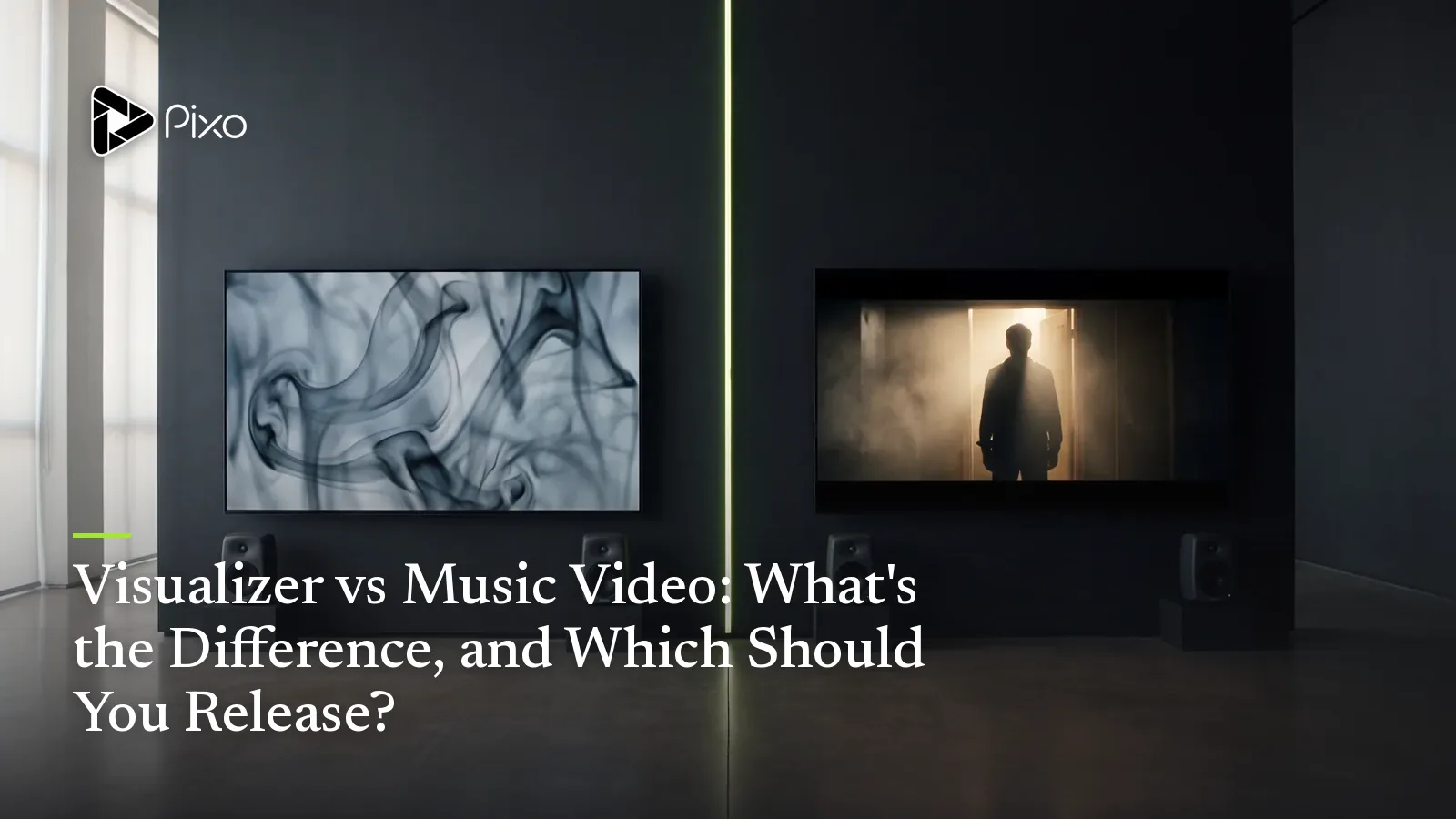
Scroll any label's YouTube channel and you'll see the same pair over and over: "Official Music Video" and, a few rows down, "Official Visualizer." Same artist, same era, wildly different production budgets. The visualizer might be a slow-rotating album cover in fog; the music video has a director, a cast, and a credits list.
The distinction matters more than most artists realize, because the two formats do different jobs, cost different orders of magnitude, and fit different moments in a release cycle. Choosing wrong wastes either money (a $15,000 video for a deep cut nobody streams) or momentum (a lead single that launches with nothing but a static cover). Here's the full comparison, and the release strategy that gets you both.
For a scene-based release visual, the audio visualizer guide explains the workflow and the distinction from real-time spectrum graphics.
The Short Version
| Visualizer | Music Video | |
|---|---|---|
| What it is | Continuous, often abstract visual over the track | Narrative or performance film built around the song |
| Storytelling | None — supports the music | Central — characters, arc, world |
| Typical cost (traditional) | $0 – $500 | $2,000 – $30,000+ |
| Typical cost (AI) | Under $15 | Under $50 |
| Production time | Hours | Weeks (traditional) or hours (AI) |
| Best for | Album cuts, release-day presence, steady output | Lead singles, defining an era, press moments |
| Platform treatment | Full video: searchable, recommendable | Full video, plus press/playlist/editorial potential |
What a Visualizer Actually Is
A visualizer is moving artwork: animated cover art, drifting landscapes, smoke and light loops, or the classic audio-reactive spectrum bars. It has no plot and doesn't need one — its job is to support the track without adding to it, giving an audio-only release a legitimate home on platforms built for video.
That last part is the real reason visualizers exist. YouTube is one of the largest music discovery surfaces on earth, and it has no meaningful slot for songs without pictures. A static "topic" upload earns near-zero recommendations; an Official Visualizer is a real video with watch time, search presence, and a thumbnail. The visualizer is the minimum viable visual — and that's not an insult. Drake ships visualizers for album tracks; BTS drops them alongside teasers before the main video lands.
The traditional catch: most visualizer tools produce the same thing — spectrum bars over a stock background — which is why so many visualizers read as placeholders. The newer approach is generating actual footage matched to the song's mood (scenes, not spectrum bars), which closes most of the aesthetic gap with a real video while keeping visualizer economics.

Create AI videos with Pixo
Turn any idea into a publish-worthy video. One sentence is all it takes.
What a Music Video Actually Is
A music video is a short film in service of a song: a narrative, a performance, a world, a face. It's the format that defines artist eras — nobody's career was changed by a visualizer, but Billie Eilish's early narrative videos are inseparable from her breakout.
The costs are correspondingly filmic. As we broke down in our music video cost guide, a professional shoot stacks director day rates ($500-$1,250), a DP ($1,000-$1,800), camera packages, locations, and weeks of post-production into budgets that start around $2,000 for a skeleton indie shoot and climb past $30,000 with a production company. A video also carries opportunities a visualizer never gets: press coverage, editorial playlisting conversations, awards, reaction content.
The traditional trade-off was brutal for independents: the format that matters most costs the most, so most tracks got nothing. That trade-off is what's collapsing — AI music video production generates storyboarded, lip-synced narrative videos from an uploaded mp3 in hours, which moves "real music video" from a once-a-year splurge to a per-release decision.
Which One Should You Release?
Choose a visualizer when: the track is an album cut rather than a single; you're between major releases and need to stay visible; the budget for this drop is already spent on the recording; or the song is atmospheric and honestly doesn't need a story on top of it.
Choose a music video when: this is the lead single; the song has a concept begging for visuals; you're building an era with a consistent world; or a press cycle is planned and needs an anchor asset.
Choose both when you can — in sequence. The playbook working for independent artists: visualizer on release day so the song immediately exists on video platforms, full music video two to six weeks later as a second moment. One track, two uploads, two thumbnails, two shots at recommendation traffic — and the video drops once you've seen whether the song is reacting, so production money follows evidence instead of hope.
With AI production the sequence gets tighter, because both assets can come from the same project: generate a mood-driven visualizer for release day, then expand that same visual world into a full narrative video with an AI music video generator — same palette, same imagery, one coherent era. Round it out with the third format this comparison usually ignores: the 3-8 second Spotify Canvas loop, which is neither a visualizer nor a video but borrows from both and runs on the platform where your listeners already are.
The Bottom Line
A visualizer keeps your song visible; a music video makes your song memorable. They're not competitors — they're different rungs on the same ladder, and the classic mistake is treating the choice as either/or when it's really a question of sequencing. In 2026 the budget excuse is mostly gone: when a visualizer costs less than lunch and a full video costs less than a mic cable, the only real constraint left is having a concept worth watching.
Generate AI summary
From idea to finished video.
In one conversation.
Start CreatingNo credit card required • Free 200 credits