MiniMax H3 vs Seedance 2.5: Which Model Is Better?
MiniMax H3 and Seedance 2.5 launched the same day. We compare length, editing, audio, multimodal input and control — and explain which model fits which job.

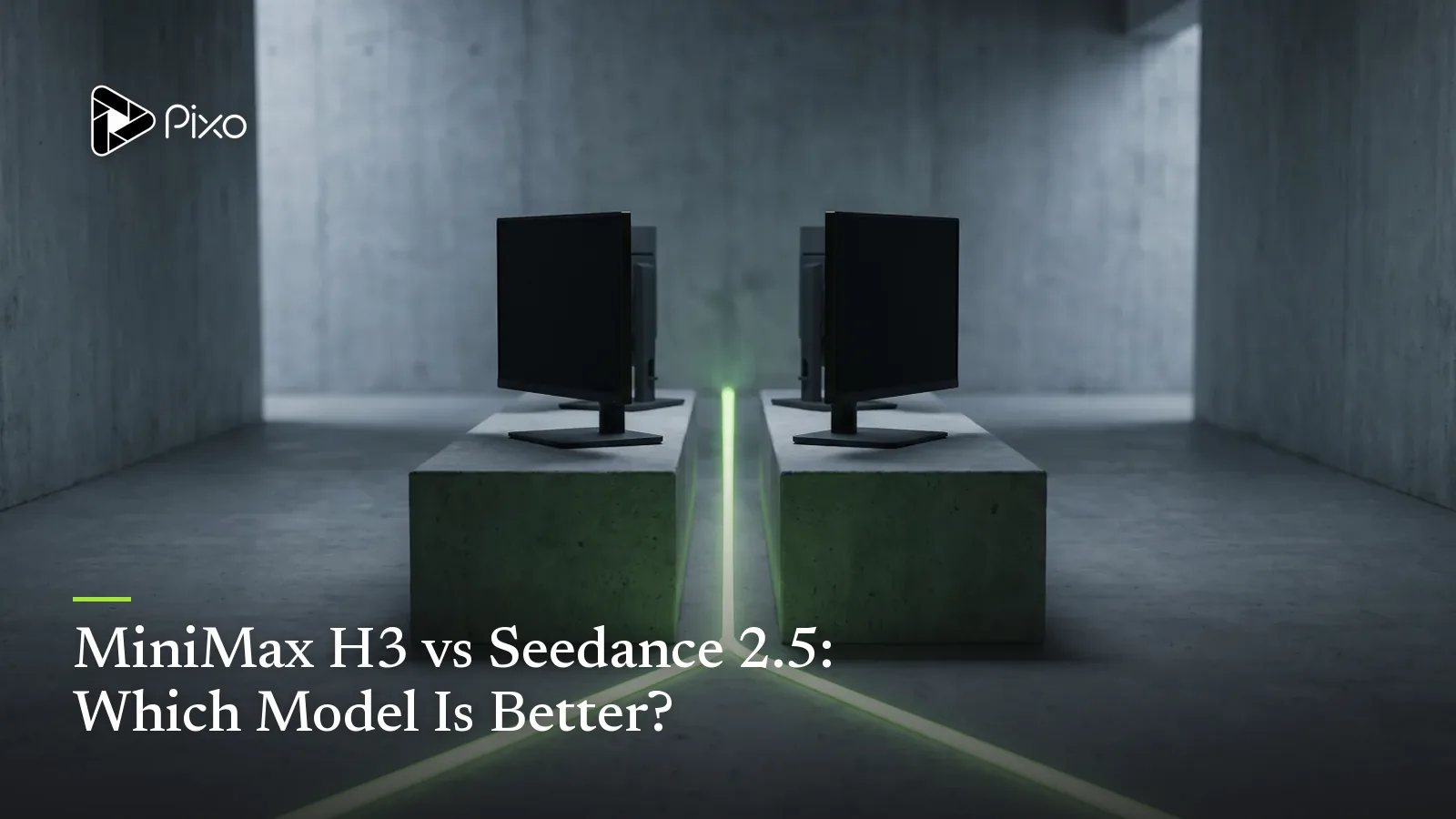
July 31, 2026 was the most crowded day in AI video's short history. Within hours of each other, MiniMax shipped H3 — its omni-modal "generate it, then edit it" model — and ByteDance rolled out Seedance 2.5, pushing single-pass generation to a previously unthinkable 180 seconds. Two flagships, one day, and one very confused creator community trying to work out which one to learn first.
We run Pixo, a multi-model video platform where Seedance 2.0 currently anchors the storyboard workflow — so we read both official manuals cover to cover the week they dropped, and we have no incentive to crown either model: our product wins when the right model handles the right shot. Here's the comparison as we see it, including several manual-level details that haven't surfaced in most coverage. (Background reading: our MiniMax H3 first look and what's new in Seedance 2.5.)
Quick Comparison
| MiniMax H3 | Seedance 2.5 | |
|---|---|---|
| Released | July 31, 2026 | July 31, 2026 |
| Max length | 4–15s per clip | 30s standard; 60s via chained extension; 180s ultra-long mode |
| Resolution | 1440p mode recommended (up to 2976×1248 @ 21:9) | High-res output (4K reference input supported) |
| Native audio | ✅ Stereo on every output | ✅ Including dialogue |
| Multimodal input | 12 files: 9 img + 3 video + 3 audio | 43 files: 30 img + 10 video + 10 audio (30s totals) |
| Audio-only input | ❌ Must pair audio with image/video | ✅ Pure audio-driven generation |
| Instruction-based editing | ✅ Characters, scenes, dialogue, voices | ✅ Smart Edit + Advanced Edit (region select, brush) |
| Timestamp control | ❌ Not documented | ✅ Second-level commands ("turn at 3s, cut at 5s") |
| Voice cloning + TTS | ✅ 11 languages precise, ~40 derivable | Voice timbre reference (upgraded) |
| Green screen / previz | ❌ | ✅ Green-screen edit + white-model (previz) control |
| Aspect ratios | Six, incl. 21:9 cinema wide | Standard set |
| Access | Hailuo AI app, open API (MiniMax-H3), third-party platforms | Jimeng (Dreamina) platform only |
How We Compare
Same method we use before adding any model to Pixo's lineup: match documented capabilities against the four jobs creators actually pay for — narrative scenes with dialogue, brand/product shots with locked identity, long-form storytelling, and the revision pass after client feedback. Both models are days old, so this comparison leans on official documentation (both companies published unusually detailed manuals) plus our production history with the Seedance line. Where a claim is manufacturer-reported and not yet independently benchmarked, we say so.
Where Seedance 2.5 Wins
Length, by a mile. H3 caps at 15 seconds. Seedance 2.5 generates 30-second clips, extends them losslessly in chained steps to 60 seconds — new frames only, original footage untouched — and its ultra-long mode produces up to 180 seconds in a single pass. For short dramas, music videos and anything with an actual narrative arc, this isn't an increment; it's a category change. (Worth knowing: community reports put ultra-long generations at a steep credit cost on Jimeng, so the 15-second economy still matters.)
Directorial control. Seedance 2.5 takes timestamped text commands — have a character turn at second 3, cut scenes at second 5 — which moves prompting from "describe a vibe" to "execute a script." Add multi-grid storyboard input (it accepts stick-figure storyboard sketches as structure references), white-model previz control for blocking and camera moves, and seamless transition generation between two input videos, and 2.5 reads like it was designed off a director's complaint list.
Input scale. Up to 30 images, 10 video segments and 10 audio tracks against H3's 9/3/3 — plus pure audio-driven generation, which H3's manual explicitly disallows (audio must accompany an image or video). For workflows built on rich reference material, 2.5 simply accepts more of your world.
Multi-person scenes. 2.5 specifically targets the "twin face" failure — multiple characters converging toward the same face — a long-tail defect that ruined many otherwise good group shots in every model, 2.0 included.

Create AI videos with Pixo
Turn any idea into a publish-worthy video. One sentence is all it takes.
Where MiniMax H3 Wins
The voice stack. H3 clones voice timbre from a reference track, rewrites dialogue with the performance adjusting to match, and speaks 11 languages precisely (~40 via derivation) — in the same system that generated the picture. Seedance 2.5 upgraded its voice-timbre referencing, but there's no equivalent of "same spokesperson, same voice, new market" as a one-prompt operation. For multi-market ad work, H3 replaces a dubbing pipeline.
Audio always on. Every H3 output ships with native stereo audio — dialogue, ambience, effects — no mode selection, no silent drafts. And notably, Seedance 2.5's manual spends real estate on removing unwanted BGM and subtitles its models sometimes inject; H3's audio defaults have felt cleaner in early community testing, though we'd call that provisional.
Format and access. True 21:9 cinema output at up to 2976×1248, six aspect ratios, and — crucially for developers — a public API from day one (MiniMax-H3, roughly $0.78 per 6-second 2K clip) with open weights promised. That openness is already compounding: within a week, H3 has surfaced across a wave of third-party creative platforms, while Seedance 2.5 stays exclusive to the Jimeng (Dreamina) platform.
The Real Story: Convergence
Strip the spec sheets away and both companies made the same bet on the same day: generation alone is a commodity; the workflow around it is the product. Both models now accept a pile of multimodal references, generate with sound, and let you revise by instruction instead of re-rolling. They differ in emphasis — Seedance 2.5 optimized for duration and directorial control, H3 for voice, language and iteration — but they're converging on the same destination: the model as a full production tool rather than a clip machine.
Which raises the practical question: why choose? A 180-second capability and a voice-cloning capability aren't substitutes — they're different shots in the same project. That's the workflow we build Pixo around: a storyboard where the agent assigns the best model per shot across Seedance, Kling, Veo, Hailuo and more. Seedance 2.0 anchors Pixo's storyboard today under the Seedance2 Director agent — and both of this launch day's flagships are already on Pixo: MiniMax H3 and Seedance 2.5 run in the Playground for single-shot work.
What About Seedance 2.0?
Still a workhorse, and still the version running in production on Pixo — 15-second multi-shot generation, 12-file multimodal input, native audio and the physics realism that made the line's reputation (the Seedance hub on Pixo covers it in depth). But it no longer defines the line's ceiling. If you're comparing against "Seedance" in August 2026, compare against 2.5 — that's what this page will keep tracking as both lines evolve.
Which Should You Use?
Choose Seedance 2.5 if your project is long-form or control-heavy: short dramas, music videos, choreographed sequences, anything where timestamps, storyboards and 30–180 second takes matter more than API access.
Choose MiniMax H3 if your work is commercial, dialogue-driven or multi-market: brand films, spokesperson content, product ads that will be localized — or if you need an API today.
Choose a storyboard, not a model, if you make complete videos. Mix models per shot on Pixo — Seedance 2.0 anchors the storyboard, and MiniMax H3 and Seedance 2.5 are live in the Playground today. Sign up now — new users get 200 free credits on sign-up, and plans are currently up to 55% off.
FAQ
Is MiniMax H3 better than Seedance 2.5?
Neither wins outright. Seedance 2.5 dominates on length (up to 180-second single-pass generation), timestamp-level control and region-based editing. MiniMax H3 wins on the voice stack — dialogue rewriting, voice cloning, TTS in 11 languages — plus always-on stereo audio and 21:9 output. Choose by the job, not the leaderboard.
Did MiniMax H3 and Seedance 2.5 really launch on the same day?
Yes — both models shipped on July 31, 2026. MiniMax released H3 via the Hailuo AI app and its open-platform API, while ByteDance rolled out Seedance 2.5 on its Jimeng (Dreamina) platform.
Can both models edit existing videos?
Yes, both now support instruction-based editing. Seedance 2.5 adds timestamped edit commands, region selection and brush tools, green-screen conversion and BGM removal. MiniMax H3 focuses its editing on characters, backgrounds, dialogue replacement and voice migration.
How long can each model's videos be?
MiniMax H3 generates 4–15 seconds per clip. Seedance 2.5 generates up to 30 seconds normally, extends clips in chained steps to 60 seconds, and its ultra-long mode produces up to 180 seconds in a single pass — currently the longest of any mainstream flagship.
Which model handles more languages?
They overlap heavily. H3's text-to-speech precisely covers 11 languages with about 40 more derivable, plus voice cloning. Seedance 2.5 optimized prompt understanding for Chinese, English, Spanish, Indonesian and Malay, with full coverage of Thai, Arabic, Portuguese, Vietnamese, Japanese and Korean.
What about Seedance 2.0 — is it still worth using?
Seedance 2.0 remains a strong, proven generator — 15-second multi-shot clips with native audio and best-in-class physics — and it's live on Pixo today under the Seedance2 Director agent. But for new comparisons, Seedance 2.5 is the flagship to measure against.
Generate AI summary
From idea to finished video.
In one conversation.
Start CreatingNo credit card required • Free 200 credits