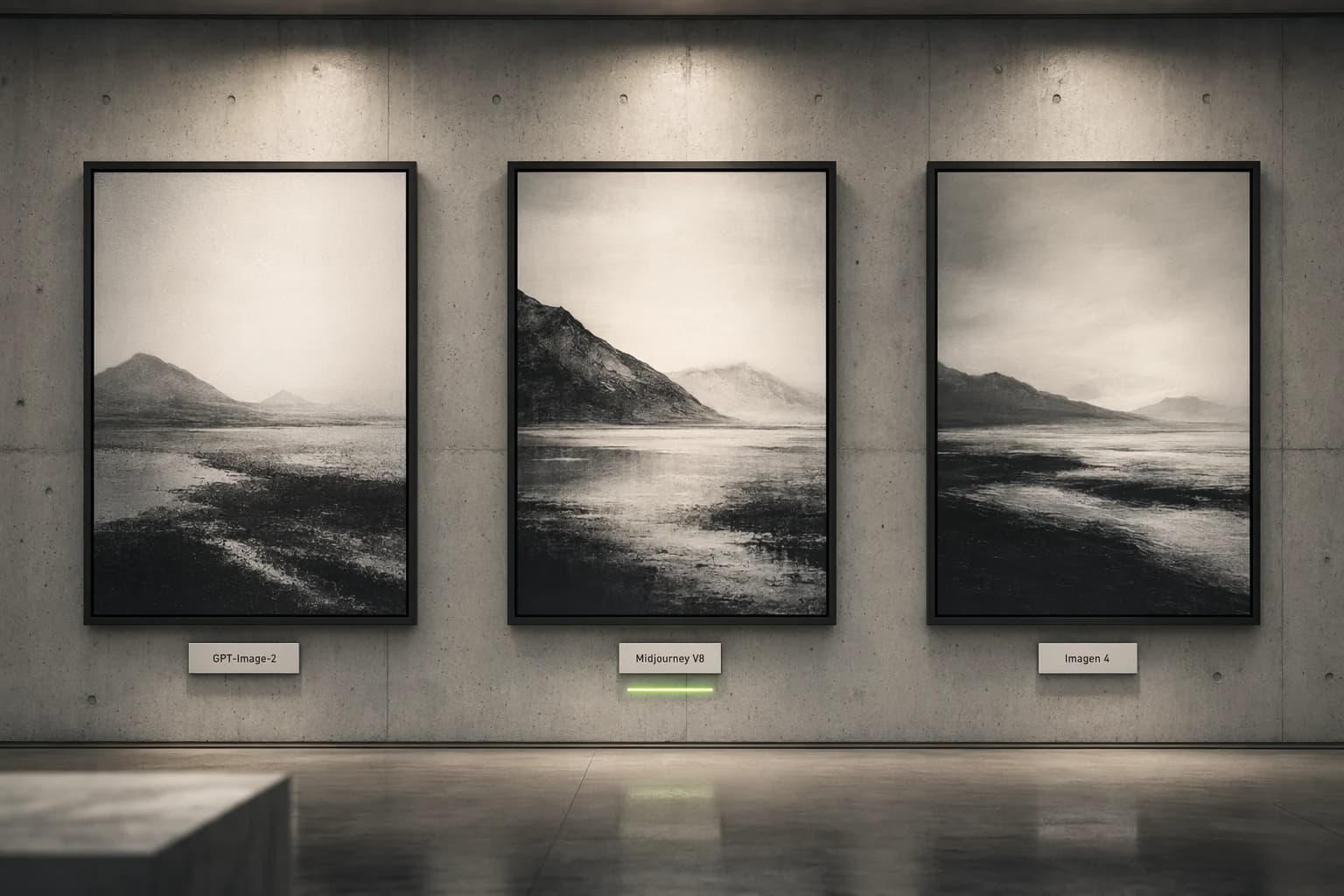
The 7 Best AI Image Generators in 2026, Honestly Compared
Compare GPT Image, Nano Banana, Seedream, Midjourney, FLUX, Ideogram, and Recraft for image quality, creative workflows, and pricing.
Picking an image model in 2026 is genuinely confusing: OpenAI, Google, and ByteDance ship a major update every few months, "open source" doesn't mean what it used to, and half the articles ranking these tools were clearly written from screenshots of other articles.
Here's a cleaner way through. We run image models in production every day — as the front end of a video pipeline, where images become character sheets, style frames, and first frames — and where our own judgment needs a check, we cite the blind-vote leaderboards rather than our taste.
The short version: GPT Image 2 is the best model overall (it currently tops both the generation and editing leaderboards), Nano Banana 2 is the best free option, and Midjourney V8 is still the aesthetics specialist. The full picture, including licenses and real prices, is below.
How we compare. Rankings cite the LMArena and Artificial Analysis blind-vote leaderboards as of early July 2026; capability and pricing claims were verified against official vendor pages on July 4, 2026. Several vendors gate pricing regionally — treat entry prices as "from" figures and confirm in-app. On July 4 we also ran our own six-prompt benchmark battery (typography, realism, cinematic, epic scale, instruction-following, product shot) through the six models we can reach by API — the side-by-side grids below are unedited outputs from that run, published with the exact prompts, and every generation time quoted in this article was measured by us during it.
Disclosure: This is the Pixo blog. Pixo is a paid multi-model creative platform; of the models below, GPT Image 2, Nano Banana 2/Pro, Seedream, and Grok Imagine are available inside it. Midjourney, FLUX, Ideogram, and Recraft are not — they're here because a list without them would be useless.
The best AI image generators at a glance
| Model | Best for | Max resolution | Text rendering | Entry price | API price/image | Where to run it |
|---|---|---|---|---|---|---|
| GPT Image 2 | Overall quality & editing | ~4K (3,840px edge) | Excellent, incl. CJK | free tier (ChatGPT) | $0.006–0.21 | ChatGPT, Pixo, API |
| Nano Banana 2 / Pro | Best free + character consistency | 4K (Pro) | Excellent | free (Gemini app) | $0.045–0.24 | Gemini, Pixo, API |
| Seedream 4.5 | Multilingual text, commercial design | 4MP | Best-in-class dense text | ~$10–15/mo (Dreamina) | $0.04 | Dreamina, Pixo, API |
| Midjourney V8.1 | Painterly aesthetics | 2K native | Improved, still behind | $10/mo (no free tier) | no API | Midjourney only |
| FLUX.2 | Open-weight ecosystem | 4MP editing | Strong | free (self-host klein) | $0.014–0.07 | Self-host, BFL API |
| Ideogram 4.0 | Typography & layout control | 2K native | 0.97 OCR accuracy | free tier | $0.03–0.10 | Ideogram app, API |
| Recraft V4.1 | Designers (vectors, brand styles) | 2048² | Strong | free 30 credits/day | $0.035–0.30 | Recraft app, API |
Pricing as of July 4, 2026. API prices are per image at standard settings — most vendors scale by resolution and quality.
For a newer budget breakdown, compare AI image generation prices by resolution and quality. Our September 10 comparison converts token, megapixel, and per-image billing into USD per output and per 1,000 images; the benchmark results here remain from July.
Same prompt, six models: what we measured
Every list like this claims testing; almost none show outputs. Here are two cases from our July 4 battery, unedited, with the prompts verbatim. Midjourney (no API), FLUX, Ideogram, and Recraft aren't in these grids — we could only automate the six models we have API access to; app-based runs for the rest are planned for a future update.
First, what the run measured about speed (average across all six prompts, one generation each, via each vendor's API at comparable quality settings):
| Model | Avg time per image |
|---|---|
| Grok Imagine Pro | 5.8s |
| Grok Imagine | 7.6s |
| Seedream 4.5 | 9.3s |
| Nano Banana 2 | 15.0s |
| Nano Banana Pro | 23.8s |
| GPT Image 2 (high quality) | 109.1s |
The leaderboard champion is also, by a wide margin, the slowest — GPT Image 2's reasoning-before-drawing approach costs real wall-clock time. If you're iterating on ideas, that difference compounds fast; if you need one image to be right, it's usually worth the wait.
Case 1 — typography and layout. The prompt asked for a Swiss-style concert poster with three exact text blocks (headline, subheadline, three lines of small print bottom-left) and a lime accent bar on the left edge:
A concert poster in Swiss graphic-design style. Large headline at the top reading "MIDNIGHT SIGNALS" in bold condensed sans-serif. Below it a subheadline "Live at the Meridian Hall — August 14, 2026". Bottom-left corner, three lines of small print: "Doors 7PM", "Tickets from $45", "All ages welcome". A vertical lime-green accent bar on the left edge. Off-white paper background, black text, flat print aesthetic, no photographic elements.
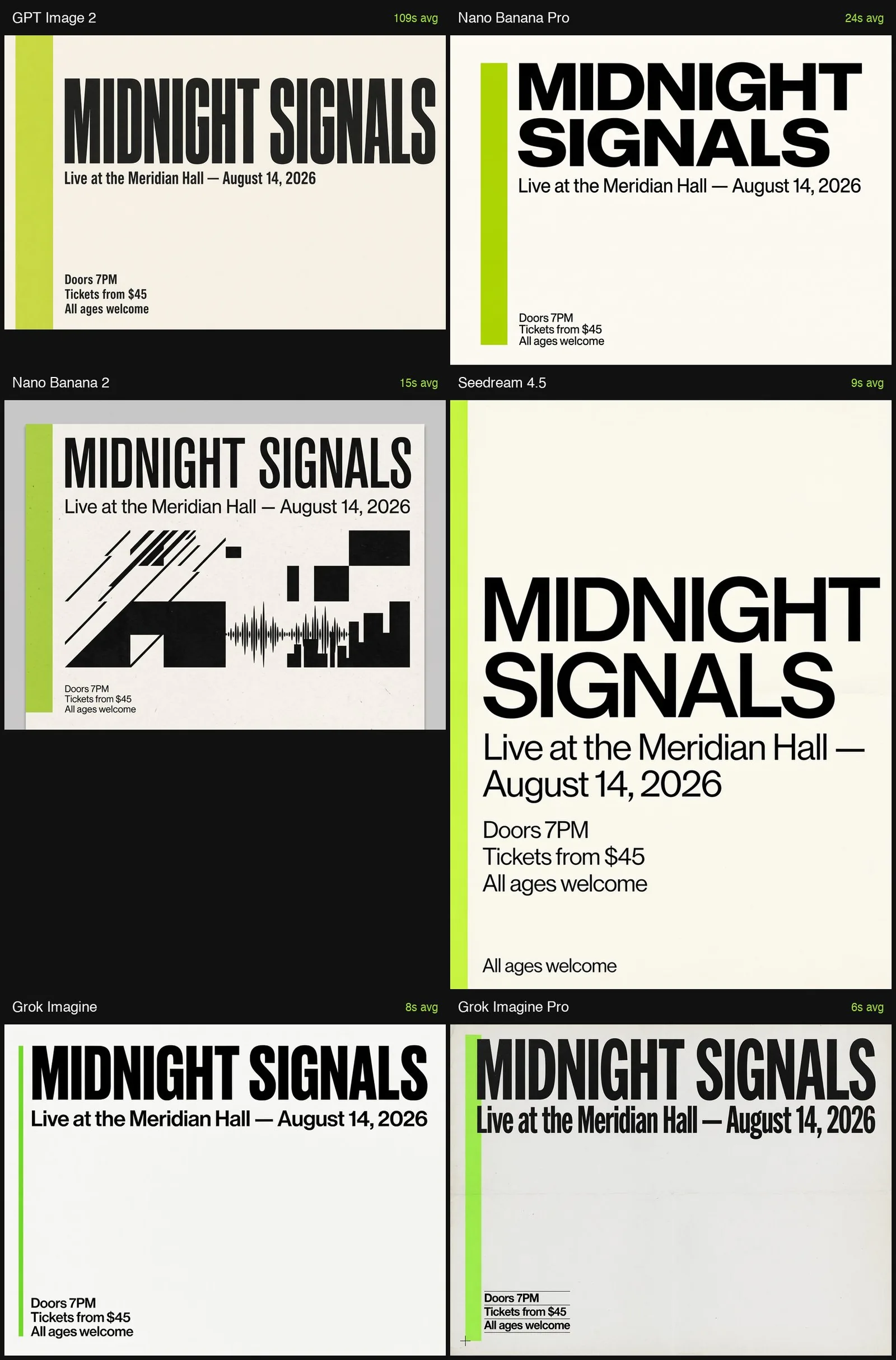
The 2026 story: everyone spells everything correctly — verbatim text rendering is solved at the top of the market. The differences are in layout obedience. GPT Image 2 followed the spatial spec most faithfully; Seedream 4.5 rendered beautiful type but duplicated a line, moved the small print to the middle, and ignored the requested aspect ratio; the Grok models got the words right with looser composition.
Case 2 — instruction following. An "exactly these eight objects and nothing else" flat lay with specified positions:
Top-down flat lay on a light oak desk containing EXACTLY these eight objects and nothing else: a silver mechanical keyboard at the center, a black fountain pen diagonally across a yellow legal pad on the left, three green apples arranged in a triangle at the top-right corner, a pair of round tortoiseshell glasses below the apples, and a small succulent in a white geometric pot at the bottom-left. Soft even studio lighting, no shadows crossing objects.
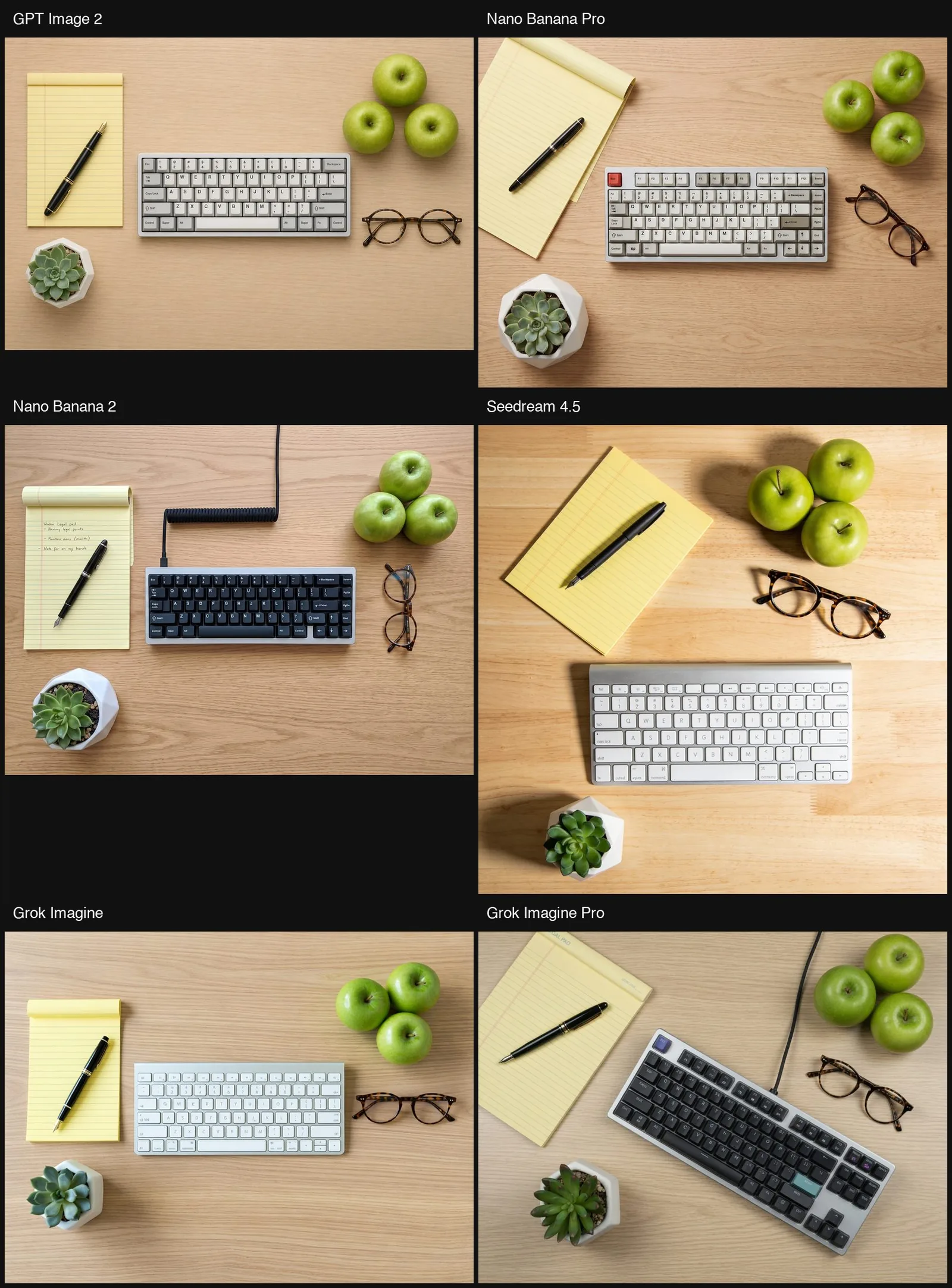
Only GPT Image 2 and Nano Banana Pro delivered clean sheets — right objects, right positions, nothing extra. Nano Banana 2 couldn't resist adding a coiled cable and turning the keycaps black; Seedream 4.5 swapped the mechanical keyboard for a flat one, pushed it off-center, and ignored the aspect ratio again; both Grok models changed the keyboard's spec. None of this shows up in a beauty contest — it's exactly the kind of thing that costs you a reroll on a real brief.
1. GPT Image 2 — best overall and best for editing
OpenAI's GPT Image 2 (April 2026) is the current king by the most honest measure available: blind human votes. As of early July 2026 it holds #1 on the LMArena text-to-image leaderboard and #1 on the image-editing leaderboard — the only model at the top of both. The reason is less about raw prettiness and more about brains: it reasons about your request (and can search the web) before drawing, so complex briefs — accurate diagrams, dense multilingual text, product shots with constraints — come back right far more often.
Strengths: leaderboard #1 in both generation and editing; reasoning + web grounding before rendering; arbitrary sizes up to a ~3,840px edge; the best instruction-following for iterative edits.
Weaknesses: slow — it averaged 109 seconds per image in our benchmark, an order of magnitude behind every rival; the good stuff is gated — "Thinking Mode" generation needs a paid ChatGPT plan; OpenAI publishes no per-tier image quotas, so free-tier limits are opaque; high-quality API calls are pricey ($0.21 per image at 1024², versus pennies for rivals at draft quality).
Pricing: ChatGPT free tier includes basic (Instant) generation; Plus at $20/month unlocks Thinking Mode. API: $0.006 (low) to $0.21 (high) per 1024² image. GPT Image 2 is also available inside Pixo.
Create AI videos with Pixo
Turn any idea into a publish-worthy video. One sentence is all it takes.
2. Nano Banana 2 & Pro — best free option and best character consistency
Google's banana-branded models are two products: Nano Banana 2 (Gemini 3.1 Flash Image, February 2026) — the fast default that's free in the Gemini app — and Nano Banana Pro (Gemini 3 Pro Image, late 2025) — the 4K flagship on paid plans. Both share the feature that matters most for production work: they hold up to 5 characters and 14 objects consistent across generations, which is exactly what character sheets and episodic content need. A budget third sibling, Nano Banana 2 Lite, landed in late June with ~4-second generations.
Strengths: the best free tier in the field; top-3 leaderboard quality; character/object consistency; Pro goes to 4K with studio lighting and depth-of-field controls; excellent multilingual text.
Weaknesses: Google's plan structure is a maze (image features scatter across AI Plus/Pro/Ultra); every output carries SynthID watermarking (invisible, but it's there); exact free-tier daily limits are unpublished; and Nano Banana 2 has a creative streak — in our instruction test it added props nobody asked for (Pro stayed disciplined).
Pricing: Nano Banana 2 is free in the Gemini app; Google AI Plus starts at $7.99/month, Pro at $19.99/month adds Nano Banana Pro, Ultra tiers ($100/$200) add 4K upscaling and volume. API: $0.045–0.151 per image for NB2, $0.134–0.24 for Pro. Both are available inside Pixo.
3. Seedream 4.5 — best for multilingual text and commercial design
ByteDance's Seedream is the model that quietly does the unglamorous commercial work: packaging mockups, posters with a paragraph of copy, product shots where the label has to say exactly what the brief says. It renders dense text — including Chinese — better than anything else in this list, outputs up to 4MP, and costs $0.04 per image via API, a fraction of Western flagship pricing. The flagship has moved on again: Seedream 5.0 previewed in February 2026 with multi-step visual reasoning and live web search during generation, rolling out through ByteDance's consumer apps.
Strengths: best dense/multilingual text rendering; strong prompt adherence for commercial briefs; up to 6 images per call; aggressive pricing.
Weaknesses: consumer access (Dreamina) has opaque, region-dependent pricing; the newest 5.0 flagship is still uneven in availability outside ByteDance's own apps; less of an artistic "look" than Midjourney or Recraft; and in our benchmark it repeatedly ignored geometry constraints — requested aspect ratios and object placement drifted in both published grids, even when the type itself was flawless.
Pricing: Dreamina from roughly $10–15/month with daily free credits (region-gated — confirm in-app). API: $0.04 per image for 4.5. Seedream 4.5 is available inside Pixo.
4. Midjourney V8.1 — best for painterly aesthetics
Midjourney remains the tool artists argue about, and V8.1 (April 2026) is its best version: about 5× faster than V7, native 2K, and meaningfully better text than its famously garbled past. When you want an image with an opinion — light, texture, composition that feels art-directed — Midjourney still produces looks the leaderboard winners don't.
Strengths: unmatched aesthetic character; fast V8 generations; a decade of community style knowledge; video generation (720p on higher tiers) as a bonus.
Weaknesses: no free tier, no API, web/Discord only; blind-vote rankings now favor GPT Image 2 and Google; text rendering still trails Ideogram/Seedream; the Disney/Universal copyright suit (consolidated with Warner Bros.) is still in discovery as of July 2026 — an unresolved risk worth knowing about before building a brand pipeline on it.
Pricing: Basic $10/month, Standard $30 (unlimited relaxed generations), Pro $60, Mega $120; commercial terms require Pro/Mega above $1M company revenue. Midjourney runs only on Midjourney.
5. FLUX.2 — best open-weight ecosystem
Black Forest Labs' FLUX.2 family (late 2025) is where the serious self-hosting community went after Stable Diffusion stalled. It spans hosted tiers (pro/flex/max, $0.03–0.07 per image) down to FLUX.2 klein, a distilled model whose 4B variant generates in under half a second and runs in ~13GB of VRAM. One correction to what you'll read elsewhere: "FLUX is open source" is only partly true. The 32B dev model is open-weight under a non-commercial license; only the klein 4B weights are Apache 2.0. Read the license before you build a product on it.
Strengths: the healthiest open-weight ecosystem (ComfyUI, LoRAs, on-device via NVIDIA/ASUS); up to 10 reference images for character/object consistency; strong typography; genuinely cheap API.
Weaknesses: license complexity trips people constantly (dev ≠ commercial-free); top-end quality sits below GPT Image 2 and Nano Banana Pro; no polished consumer app — it's a builder's model.
Pricing: klein from $0.014 per image via API, pro $0.03, max $0.07; self-hosting free where the license allows. FLUX is not on Pixo.
6. Ideogram 4.0 — best for typography and layout control
Ideogram built its reputation on one thing — writing text into images correctly — and 4.0 (June 2026) doubled down while making a genuinely surprising move: the weights are now open (9.3B, with a $300/month license for commercial self-hosting, free for non-commercial). It publishes a 0.97 OCR accuracy score, renders native 2K, and its JSON prompting lets you specify bounding-box layouts and exact hex palettes — closer to a design tool's API than a slot machine.
Strengths: best-published text-rendering accuracy; layout and palette control no one else offers; newly open weights; cheap API ($0.03–0.10).
Weaknesses: general photorealism and character work trail the flagships; the free tier is tiny (a handful of slow credits weekly, outputs public); commercial self-hosting costs real money.
Pricing: free tier; paid plans from roughly $20/month; API $0.03 (Turbo) to $0.10 (Quality) per image. Ideogram is not on Pixo.
7. Recraft V4.1 — best for designers
Recraft is the one tool on this list built for design deliverables rather than pictures: it generates real layered SVG vector files, maintains brand styles, and its V4.1 Utility Pro model (May 2026) is currently the highest-ranked text-to-image model outside Google and OpenAI on Artificial Analysis. If your output is a logo system, an icon set, or brand-consistent marketing assets rather than a hero image, this is the specialist.
Strengths: actual vector output (not traced raster); brand-style locking; top-tier benchmark showing for a non-giant; approachable free tier (30 credits/day).
Weaknesses: free-tier images are public, owned by Recraft, and non-commercial; per-image Pro API pricing runs high ($0.21–0.30 for Pro variants); it's a design tool first — freeform artistic range is narrower than Midjourney's.
Pricing: free 30 credits/day; Basic $12/month; Pro from $20 by credit volume. API from $0.035 per image. Recraft is not on Pixo.
Also worth watching
- Reve 2.0 — the quiet #2 on both major text-to-image leaderboards as of July 2026. Little brand recognition, serious quality.
- MAI-Image-2.5 — Microsoft's first top-5 image model, #2 on the editing leaderboard. Expect it across Copilot surfaces.
- Qwen-Image 2.0 / 2512 — Alibaba's line: 2.0 is API-only with 4-step generation and 1,000-token prompts; the open-weight branch (Qwen-Image-2512, Apache 2.0) is the strongest fully-open release of the past year.
- Grok Imagine — xAI's image model: fast, cheap ($0.02 per image via API), and the most permissive content policy among mainstream tools — which cuts both ways. The free-for-all era ended in March 2026; it's paid-tier now. Available inside Pixo.
- Adobe Firefly Image 5 — the commercial-safety play (trained on licensed content, enterprise indemnification) and now also an aggregator hosting 30+ partner models. Note the fine print: indemnification covers Firefly-native models only, not the partners.
What about Stable Diffusion?
Still everywhere, no longer moving. Stability AI hasn't shipped a new image model since SD 3.5 in October 2024 — the company pivoted to enterprise media deals and audio (Stable Audio 3.0 arrived in May 2026). The self-hosting energy that used to belong to SD has consolidated around FLUX.2, Qwen-Image, and other newer open-weight lines. SD 3.5 remains free for commercial use under $1M revenue and fine for hobby pipelines; it's just not where the frontier is anymore.
Where should you run them?
Same conclusion as our video generator roundup: the leaders trade blows by use case, so professionals end up needing two or three of these, not one.
- Official apps (ChatGPT, Gemini, Midjourney, Ideogram, Recraft) — first access to each vendor's newest models, but subscriptions stack up fast and your assets live in five silos.
- Aggregators (Adobe Firefly now hosts 30+ partner models; Krea and Higgsfield bundle image models alongside video) — one subscription, many models, prompt-box workflows.
- A production pipeline like Pixo — GPT Image 2, Nano Banana 2/Pro, Seedream, and Grok Imagine under one roof, but pointed at a specific job: images as the front end of video. Character sheets that stay consistent across a storyboard, style frames that anchor every shot, first frames that feed image-to-video models directly — with an agent handling which model does which. If your images are destined to become videos, that's the workflow difference. You get 200 free credits to try it on a real project.
The honest guidance: for occasional images, Nano Banana 2's free tier is all you need. For a single specialty — art (Midjourney), design files (Recraft), typography (Ideogram) — subscribe to the specialist. For production work where images feed a larger pipeline, run a multi-model platform and stop re-buying the same pixels five times.
Updates
- July 6, 2026 — Initial publication. Leaderboard standings as of July 2–4, 2026; pricing verified against official pages on July 4, 2026; six-prompt benchmark (speed measurements + published same-prompt grids) run July 4, 2026 across the six API-accessible models.
Generate AI summary
From idea to finished video.
In one conversation.
Start CreatingNo credit card required • Free 200 credits