Open-Source AI Video on GitHub: 50+ Pipelines Reviewed (2026)
We reviewed 50+ open-source AI video generators and pipelines on GitHub — agent skills, one-stop platforms, director canvases — and one architecture is winning.

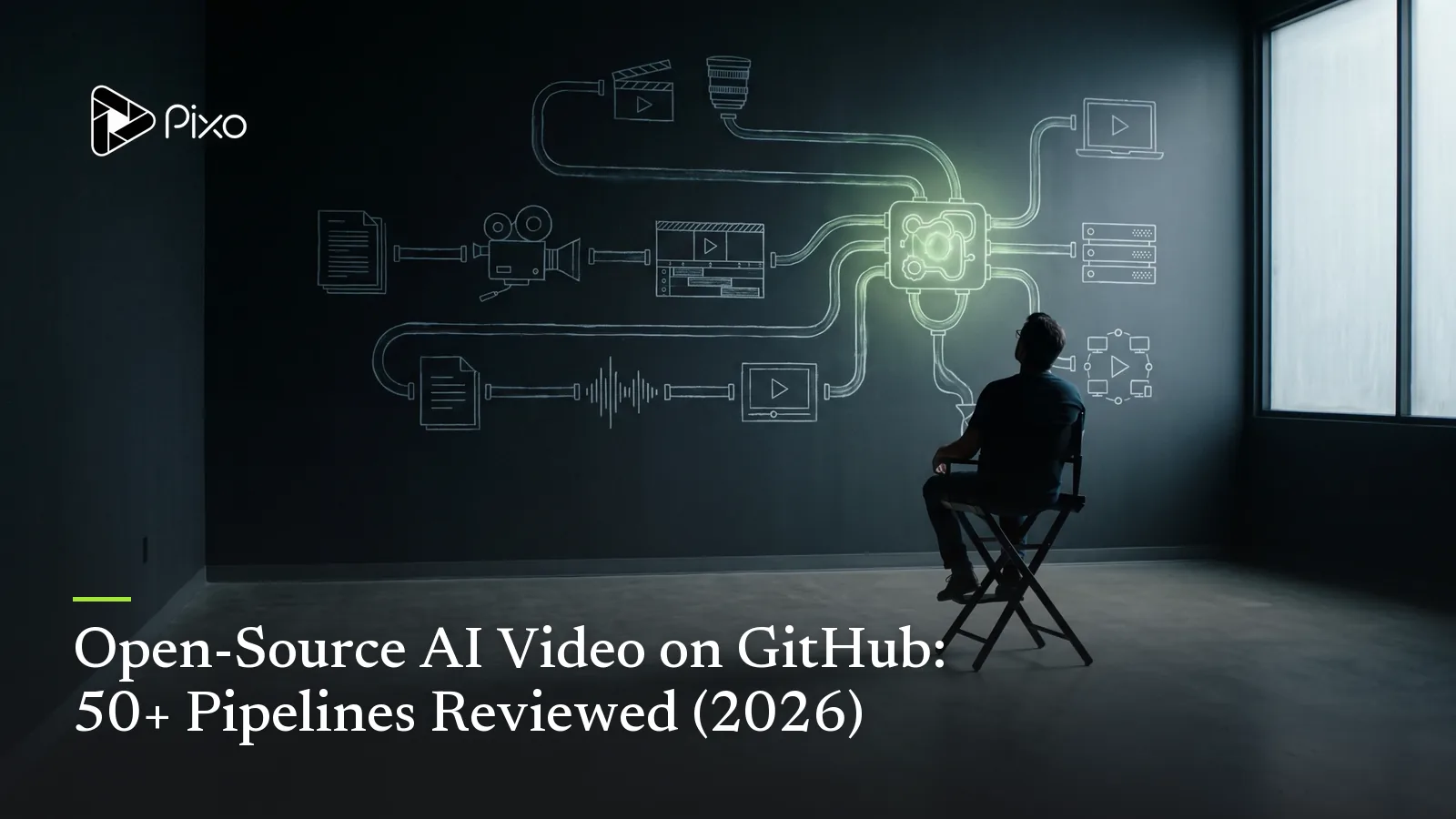
Here's a number that should get your attention: as of early September 2026, there are more than fifty open-source "script-to-finished-video" pipelines on GitHub that shipped a commit within the past month. Not fifty video models. Not fifty editors. Fifty-plus pipelines — projects whose entire premise is that an AI agent takes a story from script to storyboard to model calls to final assembly, with a human somewhere between the director's chair and the passenger seat.
We build in this exact space — Pixo is an AI video director agent that runs that same script→storyboard→generate→assemble loop as a hosted product — so we spent time going through the open-source landscape properly: reading READMEs, checking commit histories, and verifying the headline projects repo by repo. This post is what we found, organized into the three camps the ecosystem has split into, plus an honest take on where each camp's ceiling is — including the parts that are hard for one-click tools, ours included.
If you only take one thing away, make it this: almost nobody in this ecosystem is competing on models anymore. The models are rented — Seedance, Kling, Veo, and Sora appear as interchangeable backends across project after project. The competition has moved entirely to the orchestration layer: who can turn "make me a film" into a reliable production line. That matches what we argued in our AI video stack taxonomy, and the open-source world just supplied fifty-plus data points of confirmation.
The three camps at a glance
| Camp | Rough share | Representative projects | The bet |
|---|---|---|---|
| Agent skills for Claude Code / Codex | ~half | video-shotcraft, OpenMontage's skill packs | Don't build an app — package filmmaking as skills inside a coding agent |
| One-stop pipeline platforms | most of the rest | MoneyPrinterTurbo, ViMax, Toonflow | App-ify the whole pipeline: "one sentence → finished video" |
| Storyboard / director canvases | a handful | open-source infinite-canvas storyboard tools | Build the director's workbench, not the automation |
How we looked at this
Our criteria were narrow on purpose. To count, a project had to be an agent-driven production pipeline — meaning the software plans shots and orchestrates generation, not just wraps a single model API — and it had to be alive, with commits inside the last month. That filter excludes the thousand-and-one "text-to-video wrapper" repos and leaves the projects actually competing on orchestration.
For every project named in this post, we verified the repository directly this week: owner, star count, last release, and what the README actually promises versus what the code contains. Star counts below are our own same-day readings, not recycled numbers. And because we run a commercial pipeline of the same shape, we read these projects the way a line cook reads another restaurant's menu — looking for what would survive a Friday-night rush, based on the same failure modes we've had to engineer around in our own agent testing. Star counts and last-push dates in the tables below were read from the GitHub API on September 4, 2026.

Create AI videos with Pixo
Turn any idea into a publish-worthy video. One sentence is all it takes.
Camp one: filmmaking as agent skills
The most active growth in the ecosystem isn't apps at all. It's skills — packaged capabilities that plug into coding agents like Claude Code and Codex, turning a terminal into a production studio.
| Project | Stars | Last push | What it does |
|---|---|---|---|
| OpenMontage | 56.1k | 2026-08-22 | 12 production pipelines, 100+ tools, 700+ agent skill files |
| video-use | 23.9k | 2026-08-30 | Edit videos with coding agents |
| video-shotcraft | 7.4k | 2026-09-01 | Cinematic product videos with Remotion; 150+ shot recipe cards |
| Generative-Media-Skills | 4.2k | 2026-08-27 | Multi-modal image/video/audio generation skills for coding agents |
| shuohao-skills | 2.7k | 2026-08-26 | Short-drama skill set: characters, outline, scenes, script, storyboard |
| video-podcast-maker | 1.6k | 2026-09-04 | Topic → narrated 4K explainer video |
| drama-skills | 1.6k | 2026-09-04 | Full-chain short-drama skills with an independent review step |
| buttercut | 589 | 2026-09-04 | Edit video with Claude Code |
The flagship example is video-shotcraft, a skill that turns Claude Code or Codex into a motion-design studio for cinematic product videos: 150+ "shot recipe cards" with timing and easing parameters, 200+ motion previews, and a production-ready Remotion template. The maximalist version of the same idea is OpenMontage, which describes itself as an agentic video production system with 12 production pipelines, 100+ tools, and 700+ agent skill files — explicitly designed so that "your AI coding assistant IS the orchestrator," with no code orchestrator at all. And browser-use's video-use applies the same philosophy to editing: tell a coding agent "edit these into a launch video" and it removes filler words, grades color, and adds captions.
Here's the reality: this camp validates the architecture we bet on, and we still wouldn't send most creators here. The skill approach is genuinely powerful if you already live in a coding agent — the composability is real, and a single developer can ship a vertical pipeline in a week. But it inherits every assumption of its habitat: you bring your own API keys for every model, you pay every generation bill directly, and you fly blind through a text conversation. The failure mode we see constantly in agent-driven creation is losing the plot across a long project — by shot 40, nobody remembers what shot 7 looked like, and a chat log is the worst possible place to find out. Skills have no answer to that; it's a UI problem, and skills deliberately have no UI.
| What we liked | What we didn't like |
|---|---|
| Fastest-moving camp; genuinely novel packaging of filmmaking knowledge | No visual review loop — quality control is "generate and hope" |
| Zero friction for developers already in Claude Code / Codex | Bring-your-own-keys means unpredictable model bills |
| Deep vertical specialization (product promos, explainers, dramas) | No project state; long-form work loses coherence in chat |
The skills themselves are free and open source. The generation calls behind them are not — every video model call goes on your own API bill, and the retry loops agents love can multiply that bill quickly.
Best for: developers who already work inside a coding agent and want to automate a specific, well-bounded video format.
Camp two: one-stop pipeline platforms
This camp has the stars. MoneyPrinterTurbo — the grandfather of "keyword in, short video out" — passed 120,000 stars at our check, though it represents the previous generation of the idea: it assembles stock footage rather than generating shots. The current generation is agentic end to end.
| Project | Stars | Last push | What it does |
|---|---|---|---|
| MoneyPrinterTurbo | 120.4k | 2026-09-04 | Keyword → short video from stock footage — the previous generation |
| Toonflow | 15.1k | 2026-08-26 | Novels → animated short dramas on an infinite canvas |
| huobao-drama | 14.8k | 2026-09-01 | "One sentence → finished short drama", end to end |
| ViMax | 12.3k | 2026-07-29 | Director, screenwriter, and producer agents in one framework (HKU) |
| NarratoAI | 11.0k | 2026-08-29 | One-click commentary videos: script, cut, voiceover, subtitles |
| seedance-2.0 | 7.2k | 2026-08-06 | Quad-modal filmmaking pipeline built around Seedance 2.0 |
| Jellyfish | 6.3k | 2026-07-30 | Script → structured storyboard → cross-shot consistency → final cut |
| ArcReel | 4.3k | 2026-09-04 | Novel → assets, storyboard, video, and editor drafts with cost tracking |
| FireRed-OpenStoryline | 3.4k | 2026-07-31 | Intent-driven video-editing agent (RedNote) |
| lumenx | 1.2k | 2026-08-11 | Novel → short animated drama, full chain (Alibaba) |
The academically serious entry is ViMax from HKU's Data Intelligence Lab: director, screenwriter, and producer agents in one framework, with idea-to-video, script-to-video, and novel-to-video workflows. The short-drama specialists are typified by Toonflow, an open-source "AI short-drama factory" that turns novels into animated dramas via a ScriptAgent and ProductionAgent working on an infinite canvas. And NarratoAI automates the commentary-video format — script, cut, voiceover, subtitles in one flow.
What surprised us most is how much of this camp is chasing the same customer: short-drama production. A large share of the platform-type projects target the novel→episodic-drama pipeline, and "one sentence → finished film" is the standard pitch. We've spent a lot of time on AI short drama ourselves, so we'll say the quiet part out loud: one-click output is watchable, not publishable. Cross-shot character consistency, audio sync, and narrative pacing are exactly where full automation breaks, and it's telling that newer projects in this camp now advertise against "slot-machine generation" — an admission that the first wave's rework rate was brutal. The honest architecture keeps a human review gate per scene, which is precisely the part "one sentence → film" marketing erases.
| What we liked | What we didn't like |
|---|---|
| Complete out-of-the-box pipelines a non-developer can run | Output quality gap between "demo" and "publishable" is real |
| Model-agnostic orchestration is the right architecture | Self-hosting + juggling 3–5 model API accounts is a hidden tax |
| Real demand signal: short drama is a genuine market | Heavy duplication; many of these repos will not survive a year |
Free to self-host; your real costs are model API spend (typically several dollars to tens of dollars per finished minute, dominated by retries) plus your own DevOps time. Hosted products like ours fold that complexity into subscription pricing — whether that trade is worth it depends entirely on what your hours cost.
Best for: technical creators producing high-volume, format-stable content (commentary videos, short drama) who accept "good enough" output quality.
Camp three: storyboard and director canvases
The smallest camp — a handful of projects — and the one closest to how professional filmmakers actually think: not a chat log, not a black-box pipeline, but a canvas where shots live side by side.
To compare this approach with hosted tools, the TapNow alternatives guide examines canvas-based workflows alongside guided video production. Keep the hosting decision separate from how you want to plan and review shots.
| Project | Stars | Last push | What it does |
|---|---|---|---|
| aimangastudio | 1.5k | 2026-08-23 | AI manga / comic-drama production: script, storyboard, character style |
| open-ai-canvas | 802 | 2026-09-04 | Infinite canvas for AI filmmaking: storyboard sequencing, assets, agent workflows |
| open-storyboard-canvas | 323 | 2026-08-15 | Director's-desk canvas: camera control, prompt presets, custom providers |
The honest answer on why this camp is tiny: a canvas is only valuable when it's wired into a pipeline. A storyboard you can't regenerate from, that doesn't hold character consistency, that can't push an edit back through the generation loop, is just a pretty pinboard. But wire it in and it becomes the cockpit — circle a shot, say "retake this from a low angle," and the agent rewrites the prompt, re-calls the model, and refills the frame. That loop is exactly why we built prompt-driven editing and a visual storyboard as one system rather than two features: separated, each is crippled. We expect this camp to grow fastest, not from new canvas projects, but from camps one and two growing canvases.
Best for: watching where the whole ecosystem is headed.
The infrastructure layer underneath all three
One project deserves its own callout: HyperFrames (43.9k stars), HeyGen's open-source rendering engine with the tagline "Write HTML. Render video. Built for agents." The video is an HTML document — clips, subtitles, timing, and audio live in elements and data attributes, which makes compositions diffable, remixable, and native territory for code-writing agents. When an established video company open-sources its compositing layer specifically for agents, that's the industry telling you where it thinks the puck is going.
What we learned
Three patterns emerged that no single project shows on its own.
First, the pipeline beat the model. Across fifty-plus projects, essentially zero compete on generation quality; all compete on orchestration. Models are treated the way film stock was — a supplier decision. This is why we run a multi-model lineup rather than betting the product on any single model's release cadence: every model upgrade becomes a free product upgrade when your value lives a layer up.
Second, the graveyard is as instructive as the leaderboard. Some once-leading projects went quiet earlier this year even as demand kept climbing. Keeping a pipeline alive means re-tuning prompts, shot granularity, and cost models every time a major model ships — a monthly treadmill that burns out solo maintainers. Sustained orchestration is an operations business, which is exactly why it's hard to give away for free.
Third, the camps are converging. Skills lack state and visual review; platforms lack fine control; canvases lack pipeline depth. Each camp's gap is another camp's core feature. The endgame — a conversational director agent, a visual storyboard, and multi-model orchestration in one system — is the shape every serious commercial product, ours included, is already converging toward. The open-source world is speed-running the same conclusion in public.
How to choose
If you're a developer who wants to understand the architecture — read ViMax and OpenMontage source. Running one pipeline end to end will teach you more than any blog post, including this one.
If you live in Claude Code and want to automate one format — pick the skill closest to your niche (video-shotcraft for product promos), set a hard budget on model spend, and treat retries as the cost center they are.
If you're a creator whose goal is publishing, not plumbing — the hidden cost of self-hosting will come out of your creative time. Compare hosted generators instead, pick one, and spend your energy on the work.
If you're evaluating the space — watch the stalled repos and the corporate entrants, not the star counts. Both tell you more about where value actually accrues. And when a major engine ships an update — Seedance's releases being the recent example — watch which pipelines absorb it within a week. That absorption speed is the real moat metric in this ecosystem.
Methodology note: we reviewed the open-source AI video pipeline landscape on GitHub as of early September 2026, scoped to agent-driven script→storyboard→generate→assemble pipelines with commits in the trailing month (50+ repos). Every project named above was verified directly — owner, stars, release history — on the day of writing; star counts are our same-day readings.
Generate AI summary
From idea to finished video.
In one conversation.
Start CreatingNo credit card required • Free 200 credits